
A Leader Worth Following
"Organizations whose leaders evolve their thinking and actions to view the business world through the lenses of others and direct their words and behaviors accordingly will create better experiences for employees, customers, and everyone who interacts with them. And if they invest in their leaders and the environments they create for them for the long haul, they'll reap better financial and operational outcomes."
–Benjamin Granger
There’s a dangerous misconception causing most AI initiatives to fall short of expectations, despite an aggressive push for investment by the boardroom and C-suite. Research from Gartner and MIT reveals that more than 40% of agentic AI projects and a staggering 95% of generative AI efforts fail to meet ROI expectations.
Why is this? It’s because too many organizations approach AI as a technology initiative, rather than as a leadership and change management challenge.
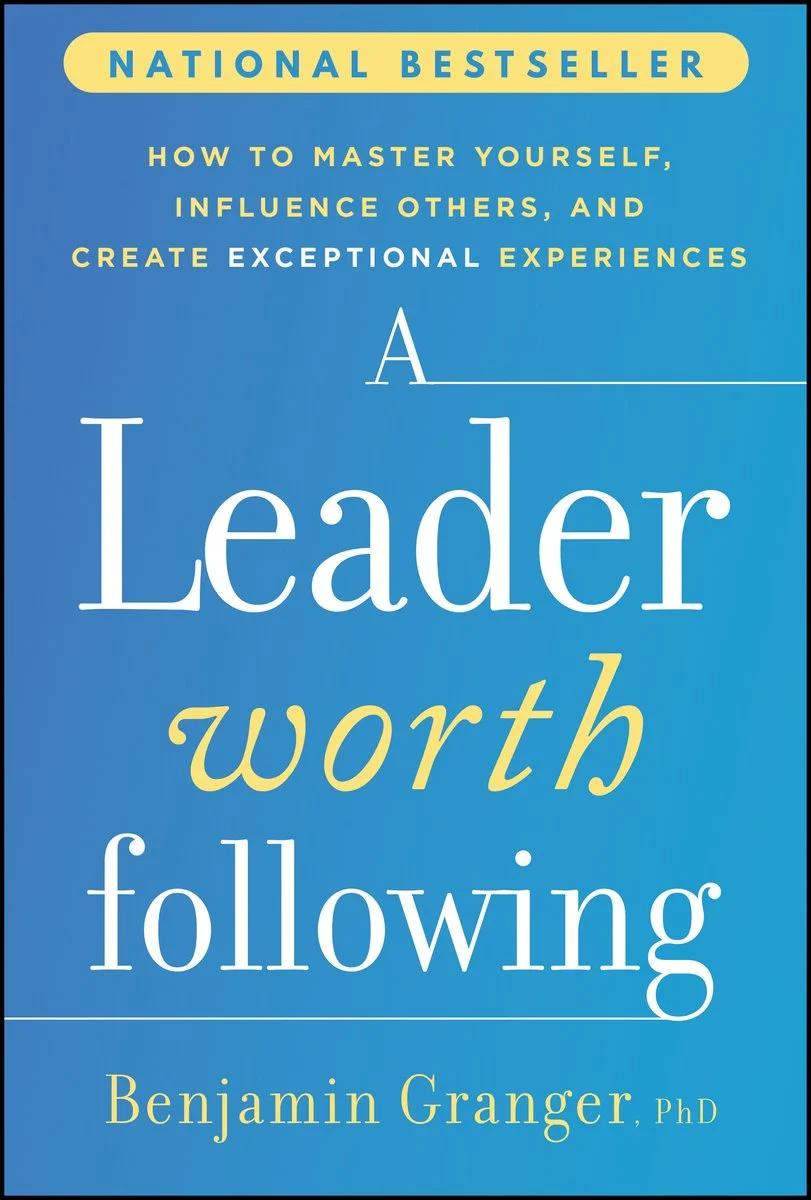
To realize the potential of AI to create business value, organizations need new workflows, new governance models, and new operating structures. But beneath all of that sits something far more consequential: whether leaders create environments where people feel energized, trusting, curious, and psychologically safe enough to navigate unprecedented change together. That’s why Dr. Benjamin Granger's A Leader Worth Following is so timely — and frankly, so important.
Granger reminds us that leadership is still fundamentally human. The organizations that thrive in a rapidly changing world will not simply be the ones with the best algorithms. They will be the ones with leaders capable of shaping cultures that help their employees adapt, learn, experiment, and grow together.
This has been a central theme in the Substack series Randall Rothenberg and I have been collaborating on together called Winning Experience. In our latest article, we focus on how the rise of AI is elevating the importance of leadership experience, because as technology accelerates the pace of change, the future belongs to organizations capable of combining AI with human judgment, empathy, and creativity. This requires leadership focus on a system of change that is well aligned to your culture.
That’s exactly the journey that Granger’s book takes us on together. A Leader Worth Following is not specifically focused on AI, but its lessons are directly applicable for leaders aiming to create value through the connection of AI to customer and employee experience.
Granger, Chief Workplace Psychologist at Qualtrics and one of the leading voices in Experience Management (XM), makes a compelling case that great organizations are shaped by leaders and how they show up with the people they lead.
That idea sounds simple, but it has enormous implications.
Too many organizations still think about leadership through the lens of operational execution. Leaders are rewarded for delivering quarterly numbers, optimizing systems, driving efficiency, and in many cases chasing survey scores. Then leaders wonder why innovation stalls, experimentation disappears, and employees disengage under pressure.
Granger pushes leaders to think differently.
Leadership is not merely about directing activity. It is about shaping environments and the organization’s culture.
That framing connects well to the work I’ve been doing with James Killian, Ph.D. and Simon Robinson Robinson around Leadership Experience (LX). Through our LX Accelerator (www.lxaccelerator.net), we’re focused on how to amplify the ROI for investments in customer experience (CX) and employee experience (EX) through intentional focus on LX. Value = LX x (CX + EX).
Leaders are the multiplier in your system of change.
They amplify energy — or drain it.
They create clarity — or confusion.
They reinforce curiosity and open-mindedness— or fear.
And in a world increasingly shaped by AI-driven disruption, the multiplier effect of LX becomes even more critical.
One of the strongest themes throughout Granger’s book is the importance of higher ground thinking, something that I first wrote about with my colleague Sujay Saha when we were at PwC together years ago in our cover story in Strategy + Business titled ROX^3: Boosting Returns on Leadership, Customer, and Employee Experience.
The best leaders resist the urge to act impulsively, reduce complexity into simplistic binary choices, or optimize purely for short-term outcomes. Instead, they engage broader perspectives, encourage open mindedness, and seek to understand the experiences of others before acting. Higher ground thinking requires practicing mentalism, which involves thinking about what others are thinking and feeling, and are likely to do next. It contrasts with lower ground thinking, which leverages one’s own experience and intuition to make decisions rapidly and with less mental energy (note higher ground thinking is also often called Thinking Slow and lower ground thinking is often called Thinking Fast).
Granger operationalizes those ideas beautifully. It’s not that you should never engage in lower ground thinking. After all, our brains are hard wired to make the vast majority of choices based on unconscious thought and emotion. Life would be very hard otherwise, and our species would not have evolved the way it has. Indeed, customer and employee loyalty are both habit building loops where we crave specific feelings aligned with the brand promise and employee value proposition.
More effective leaders strengthen their higher ground mental muscles and make better decisions where more multi-disciplinary perspective is required. They remain intellectually curious even under pressure. They raise the energy of their culture by modeling the right behaviors with one another and their teams.
As AI compresses the time between insight and action — and as the task of leaders shifts from authorship to orchestration — higher ground thinking becomes more valuable.
That’s why Granger’s work feels so connected to Bernie Jaworski's The Soul of Strategy and Gerald Zaltman's Dare to Think Differently — two books I reviewed recently. I enjoyed having Jaworksi on my podcast to talk about his book (see episode #78 here) and am looking forward to having Zaltman and Granger on in the next couple months, too.
Like Granger, Jaworksi encourages leaders to cultivate behaviors for curiosity and open-mindedness, reinforcing an evidence-based approach to strategy and organizational change. Zaltman emphasizes similar leadership behaviors, while going deeper on the importance of building insights into emotion and metaphors shaping human behavior beneath the surface.
Granger brings those ideas into the daily practice of leadership. He reminds us that humans are not rational optimization machines. We are emotional, social, meaning-seeking beings constantly interpreting signals from our environments.
Through body language.
Through active listening.
Through symbolic actions.
Through the questions we ask — or fail to ask.
Granger’s iceberg model of culture reinforces the idea that these visible artifacts are merely surface manifestations of deeper values and underlying beliefs. Leaders influence culture through habitual behaviors that shape how people feel, think, and interact. Zatlman also uses the metaphor of an iceberg to talk about how emotions and unconscious thought influence our thinking.
Culture, ultimately, is about the flow of energy across the organization, through the combination of mindsets, skills, relationship networks, and behaviors. Some cultures generate momentum, curiosity, experimentation, trust, and optimism. Others consume energy through fear, politics, uncertainty, and disengagement.
Leadership determines whether energy flows or is drained. That’s why Leadership Experience matters so much right now.
Boards and CEOs are pushing their organizations to move faster on AI. CEOs are asking leadership teams to accelerate change. But transformation without intentional focus on leadership experience creates exactly the wrong conditions: anxiety, fragmentation, exhaustion, resistance, and performative adoption. Without intentional focus on LX, you risk draining the energy in your culture and seeing your AI efforts fail. This is why culture eats strategy for breakfast. It is the root of the CX & Culture Connection, the name of my own book and podcast.
Organizations don’t need leaders who simply deploy AI tools. They need leaders capable of helping humans navigate their change journey meaningfully. We are all on a journey to improve our LX, CX, and EX, and your intentional focus can be the spark of energy on that journey (that’s the meaning behind the name JourneySpark).
As Granger writes in A Leader Worth Following, that requires empathy. It requires perspective-taking. It requires vulnerability. It requires the ability to create environments where experimentation feels safe and learning feels continuous. And critically, it requires leaders to shape those behaviors together.
Throughout the book, Granger reinforces the importance of reciprocity-based leadership. The best leaders earn followership by creating trust and helping others grow.
That distinction is one of the defining leadership differentiators of the AI era.
Technology may automate workflows, but humans still choose whom they trust. They still decide whether environments feel safe enough to contribute ideas. They still determine whether cultures reinforce collaboration or defensiveness. And ultimately, they still decide whether leaders are worth following.
That’s what makes this book so valuable.
A Leader Worth Following is not really a book about managing others. It’s a book about becoming the kind of leader capable of creating better human experiences at scale.
And in a world increasingly shaped by AI, that is the single most important competitive advantage of all. Because the future will not belong to leaders who simply move fastest. It will belong to leaders worth following.