
Dare to Think Differently
“Viewing open-mindedness as a set of six practical actions encourages their being cultivated to form habits. Thus, being open-minded is not a static quality that comes about in a vacuum. It can - and must be - continuously developed. When this occurs, it results in greater imagination and creativity."
–Gerald Zaltman
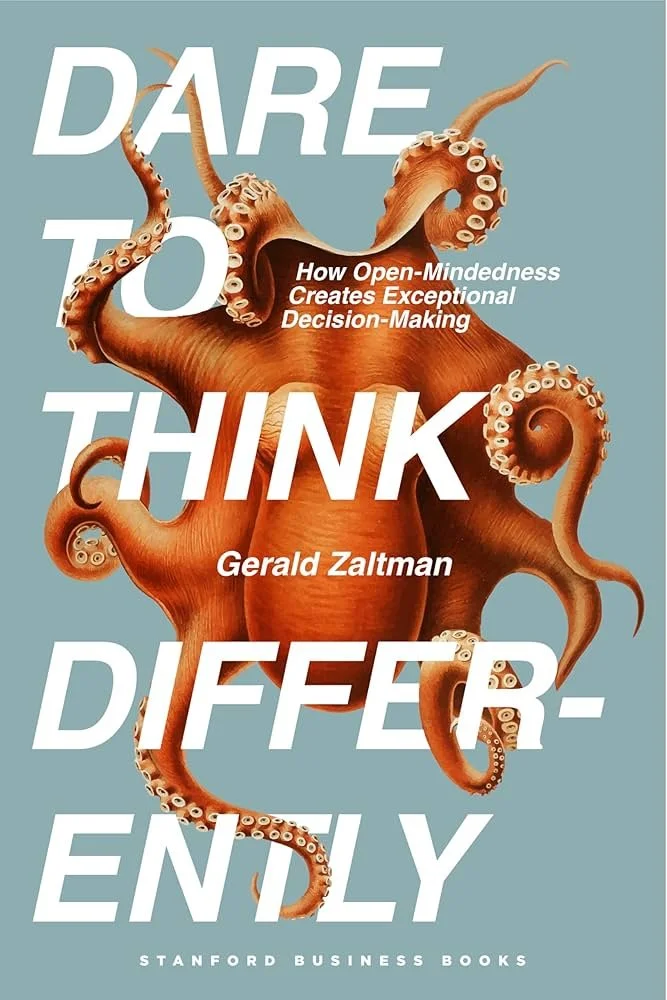
Most leadership teams don’t have a strategy problem. They have a thinking problem.
In Dare to Think Differently, Gerald Zaltman, professor emeritus at the Harvard Business School, shows how leaders who consistently outperform aren’t the most intelligent—they’re the most open-minded. He emphasizes that open-mindedness isn’t a personality trait. It’s the result of cultural behaviors that can be nurtured, reinforced, and scaled.
In a world obsessed with AI, data, and optimization, the real competitive advantage is far more human—the willingness to question what you think you know. This is why culture eats strategy for breakfast. The cultural behaviors practiced by an organization’s leaders either support or erode effective decision-making. If good strategic ideas aren’t translated into the right habitual behaviors across your managers and frontline employees, the strategy doesn’t take hold and energy dissipates.
What Makes a Leader More Effective?
Let’s start with the uncomfortable truth.
Most strategy decks are just well-formatted confirmation bias.
That’s what makes Gerald Zaltman’s Dare to Think Differently so relevant and powerful. It doesn’t offer a new framework or a better model. The book shares actionable insights for something much deeper: How we think.
Zaltman’s core argument is simple—and hard to ignore once you see it: The leaders who consistently out-innovate and outperform are not smarter. They are more open-minded.
Not casually open-minded. Disciplined open-minded.
That distinction matters. Because what Zaltman is really describing is not a mindset. It’s a set of cultural behaviors.
If you’ve read How Customers Think, also by Zaltman, you’ll recognize the foundation: most decision-making happens below the surface. It’s emotional, metaphor-driven, and shaped by mental models we often don’t even realize we have.
But his latest book goes further.
It’s still relevant for understanding customers, and how to build more meaningful insights to guide brand strategy, customer experience design, and product and service innovation. It’s also about understanding our roles as decision-makers, which in turn impacts customer and employee experience.
This is why leadership experience (LX) is so important. As I’ve shared before in prior reviews and on my podcast, Value = LX x (CX + EX). Embedding more effective decision making into the culture of your organization through intentional focus on leadership behaviors and how to make them habitual is a huge contributor to this value equation.
That’s where the connection to Bernie Jaworski's The Soul of Strategy becomes clear (see my review for Bernie’s book here and my podcast discussion with Bernie here). Like Zaltman, Jaworski also argues that strategy is a function of leadership behavior—curiosity, evidence-seeking, abandonment of outdated assumptions.
Zaltman extends those insights beyond strategy to a broader canvas of leadership decisions. His “Am I / Are We” questions at the end of each chapter aren’t just reflective exercises. They’re behavioral forcing functions. Embedding these questions into regular practices turns commitments into habitual behaviors, which are core to culture evolution.
The six leadership behaviors to strengthen organizational effectiveness
Dare to Think Differently is organized around six actions of an open mind:
Serious play
Befriending ignorance
Asking better questions
Indulging curiosity
Panoramic thinking
Embracing ambiguity. Most organizations say they value all six.
Few practice them systematically across all levels of the organization.
Take “serious play.” Everyone loves the idea of creativity—until it threatens timelines, budgets, or hierarchy.
Serious play isn’t about fun. It’s about permission. Permission to explore. To reframe. To be wrong in public.
It’s something I’ve seen repeatedly in Experience Collage sessions, which focus on combining insights from a variety of sources (including qual and quant research, as well as modern ways to mine unstructured data signals with AI) to dive into emotional connections customers have with your brand through usage, meaning, sharing, and community. When teams move beyond dashboards and share stories, images, and emotions, something shifts. They stop defending positions. They start building shared understanding, and co-creating solutions that address the questions they ask of each other.
Befriending ignorance (or why expertise is overrated)
Zaltman makes a point that should make every leadership team uncomfortable: The best decision-makers are the most aware of what they don’t know.
Not as a weakness, but as a catalyst for increased understanding and creating a safe space for teams to contribute their best thinking.
This is something Lou (Lewis) Carbone has long emphasized—and is one of the many reasons I value collaborating with him. Lou often credits Gerald as a mentor, and both of their thinking has had a big impact on my own.
Experience management (a phrase Lou invented in his 1994 article with Stephen Haekel) is about shaping expectations, emotions, and meaning. That requires a deeper understanding of all the clues that shape customer and employee interactions along the customer journey. Lou focuses on cultivating the “clue consciousness” of your employees so that employees can share insights and take ownership together of driving improvements. Practicing the six leadership behaviors that Zaltman focuses on in his latest book will reinforce your organization’s ability to cultivate clue consciousness and act on it more systematically.
Learning to Look in New Ways
Zaltman’s “four ways of knowing”—science, reason, intuition, imagination—encourage fresh perspectives, connecting the dots, and spotting clues that are sometimes hidden below the surface.
Most organizations over-index on the first two. The ones that win integrate all four. Because insight doesn’t come from more information. It comes from better interpretation.
Learning to look is key to unlocking your imagination, which is a prerequisite for creativity and innovation.
The ability to envision what’s missing. To connect dots that don’t obviously belong together. In an AI-driven world, this becomes the dividing line. AI can optimize. It can’t imagine in the way humans do—where unconscious and conscious thinking “whisper to each other,” as Zaltman puts it.
That’s not a bug. That’s your advantage. If you know how to use it. Advances in AI are enormously beneficial, especially if you break down strategic challenges into the right questions and prompt the AI to explore how others have solved them. This then serves as a catalyst for human creativity and innovation, rather than a replacement for it.
Another colleague that I greatly enjoy collaborating with is Simon Robinson, author of Designing Customer Experiences with Soul.
In my conversations with Simon, we keep coming back to the same idea: The issue isn’t lack of data. It’s lack of perspective.
I’m excited to team with Simon and James Killian, another recent podcast guest, on our LX Accelerator (www.lxaccelerator.net), which combines our diagnostic tools with experiential catalysts like workshops and leadership training to help leaders tackle disruptive change at their organizations. Some examples of disruptive changes the LX Accelerator is meant to address include:
Driving adoption of AI and new ways of working across the organization
Delivering your brand promise through better CX
Increasing alignment across marketing, sales, and service to accelerate growth
Reading Dare to think Differently resonated with me because so many of the insights in Zaltman’s book are aligned with the way Simon, James, and I are focused on engaging leaders to address these disruptive changes.
Final Thoughts
When culture eats strategy for breakfast, its often because leaders don’t invest enough energy into fostering greater open-mindedness, among executives, managers, and frontline employees alike.
You don’t need another offsite and motivational speaker. You need a different way of working. A way to make:
Mental models explicit
Assumptions challengeable
Curiosity habitual
Collaboration real