
The Soul of Strategy
“The purpose of a business is to create a customer. To do so, we must create organizations worthy of that customer’s loyalty, trust, and admiration. Thus, the future of strategy is when the customer is at the center, and the soul of the firm is aligned accordingly.”
–Bernie Jaworski and David Sprott
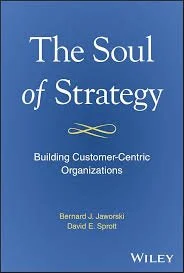
Strategy has never been more sophisticated—and rarely felt hollower. AI is accelerating the pace of innovation. Companies are racing to retool their organizations and change the way work gets done. Yet many leadership teams quietly sense the same thing: strategy has become something we analyze, not something that inspires people to act.
That is why The Soul of Strategy, by Bernie Jaworski and David Sprott, matters right now. This is my second review for one of Bernie’s books, and once again he delivers a thought provoking take on the nature of leadership and how to build more effective organizations that bring their mission, vision, and purpose to life.
Bernie Jaworski is the Drucker Chair in Management at Claremont Graduate University, where Peter Drucker taught for more than three decades. Prior to Claremont he was a senior partner at Monitor Group, where he co-led the ecommerce practice.
Dave Sprott is the Henry Y. Hwang Dean and professor of marketing at Claremont Graduate University. His research has been published in top journals such as Journal of Applied Psychology, Journal of Consumer Research, Journal of Marketing, Journal of Marketing Research, and Journal of Retailing.
Jaworski and Sprott make a deceptively simple claim: modern strategy has lost its soul. In the pursuit of competitive advantage, efficiency, and analytical rigor, we have too often pushed the customer to the margins—treating them as a variable rather than the animating force of the firm. Their answer is not nostalgia. It is a clear-eyed call to put customer-centricity back where it belongs: at the center of strategy itself.
Revisiting Drucker — Strategy Begins with the Customer
At its heart, The Soul of Strategy is a contemporary extension of Peter Drucker’s enduring idea that the purpose of a business is to create a customer. Jaworski and Sprott argue that while we have built ever more elegant models of competition, resources, and execution, very few strategy frameworks start with the customer as the animating force of the organization. They also share compelling insights about leadership, culture, and how to better link customer and employee experience in pursuit of customer-centric strategy.
They walk through the four dominant schools of strategy—external positioning, internal resources, operational excellence, and dynamic capabilities. Each school adds insight. Each has shaped generations of leaders. But in each, the customer appears as a data point or market force—not the central protagonist in the story.
That critique resonates deeply with my own experience in strategy consulting, including my 15 years as a partner at Booz & Company and PwC (which acquired Booz and rebranded it Strategy&) working on digital and customer experience transformations with a focus on culture and change management. The book’s emphasis on leadership behaviors and cultural alignment strikes a chord for me, as I launched JourneySpark to support leaders on their companies’ journeys to be more customer-driven and amplify the energy of their people through scalable cultural movements.
What Does Customer-Centricity Actually Mean?
Despite decades of research and thousands of articles on customer-centricity, practical clarity has remained elusive. The authors define customer-centricity as an organization-wide commitment to serve chosen segments through evidence-based choices that create mutual value.
This is not about slogans. It is not about journey mapping artwork. It is about a disciplined and coherent set of choices.
According to the authors, customer-centric organizations:
Are explicit about which customers they serve—and which they do not
Shape markets rather than passively respond to them
Make hard trade-offs about where to invest
Practice systematic abandonment to make room for innovation
That last point—abandonment—is one of the book’s most poignant contributions. Innovation without abandonment leads to overload. Strategy without stopping anything becomes aspiration without disciplined execution.
This idea aligns strongly with themes I explored in my own book The CX & Culture Connection, particularly around leadership capacity and the need to focus the leadership attention of an organization on building and renewing a sustainable growth flywheel.
Strategy as a Living System
One of the book’s most useful contributions is framing strategy as a cascade of customer-centered questions:
What do customers truly value?
Who are their real alternatives?
What differentiates us in ways that matter to them?
How do we create mutual value?
How do we continue to evolve?
Strategy, in this view, is a living system through which the leaders of an organization continuously learn and adapt.
This connects closely with Ken Favaro's argument in Real Strategy—that every real strategy stands on the shoulders of a big idea rooted in customer choice. I had the privilege of discussing this with Ken on my podcast (see episode #59 here).
Like Ken, Bernie and David emphasize that strategic choices must be constantly tested against evolving customer needs—and abandoned if they no longer resonate with them.
Bridging Strategy and Consumer Behavior
Where The Soul of Strategy truly stands apart is in its integration of macro strategy and micro human behavior. Traditionally, strategy and consumer psychology lived in separate domains. One is analytical and structural; the other emotional and behavioral.
Jaworski and Sprott argue they cannot be separated.
Emotion, social influence, and post-purchase experience are central to value creation. Customers do not simply purchase features; they pursue outcomes, identity, belonging, and meaning.
This perspective aligns closely with my own approach to creating an Experience Collage™ Canvas with clients. Customer experience is like collage artwork, operating in layers and the fusing of diverse perspectives. Effective experience design fills the full canvas, extending beyond the functional benefits of products and services to foster deeper meaning, sharing, and community around the brand.
Leadership — Where Strategy Gets Its Soul
The third section of the book focuses on building a customer-centric organization. Here, leadership becomes central.
Strategy does not live in frameworks. It lives in daily decisions and habitual behaviors.
Customer-centric leaders:
Demonstrate deep curiosity about evolving customer needs
Challenge assumptions
Lead through uncertainty
Balance present performance with future innovation
Align formal systems and informal culture
Jaworski and Sprott describe effective leaders as ambidextrous—comfortable holding tension between operational excellence and experimentation.
This aligns powerfully with the work I’m doing together with my colleagues Professor James Killian, Ph.D. and Simon Robinson on our LX Accelerator (www.lxaccelerator.net). Both James and Simon have been on the podcast, and I’ve also reviewed Simon’s book Designing Customer Experiences with Soul. Stay tuned for the upcoming release of James’ book: The Customer-Driven Leader, which is also the name of his podcast.
In our LX Accelerator, we focus on cultivating leadership experience (LX) that enables leaders to translate strategy into lived behavior. In my podcast conversation with James (see episode #68 here), we explored James’ four leadership archetypes: customer-avoidant, customer-tolerant, customer-centric, and customer-driven. The alignment with The Soul of Strategy is striking.
Culture Eats Strategy for Breakfast — Still
The book reinforces a difficult truth: structure is rarely the root problem. Culture is.
Fewer than one quarter of organizational redesign efforts materially improve performance. Without cultural alignment to mission, purpose, and strategy, no org chart will solve this central challenge to organizational change and leadership.
Bernie and David emphasize that mission, vision, purpose, culture, and strategy must operate as a coherent whole. Talent systems, incentives, and accountability mechanisms must reinforce—not sap—the organization’s customer promise. Culture either lifts up the energy of an organization, or it erodes it and leads to a string of failed change efforts.
This is precisely why leadership experience (LX) matters, and why it is a multiplier for customer experience (CX) and employee experience (EX). Value = LX x (CX + EX).
Formal change levers like organization structure, decision rights, and performance metrics create rational compliance. Informal change levers like relationship networks, commitments, and storytelling are often more effective at turning values statements into tangible behaviors and lasting employee habits. Building a more customer-centric culture that aligns to your organization’s mission, vision, and purpose requires a holistic system of change that addresses the right combination of formal and informal change levers.
Purpose — Beyond the Customer to Society
In the final section of their book, Bernie and David broaden the lens to the role of purpose. Drawing again on Drucker, they argue that management is a means to a larger end—a functioning society.
Purpose is not a branding exercise. It is a strategic amplifier.
Employees and customers increasingly expect organizations to create value beyond profit. Purpose-driven organizations enjoy higher engagement, loyalty, and trust. The cost of ignoring purpose—boycotts, disengagement, reputational damage—is real and rising.
This echoes themes Bernie explored in his earlier book that I also reviewed, Creating the Organization of the Future, which makes a fun linkage between Drucker and Confucious. Both Drucker and Confucius cared about peoples’ values, growth, and personal development. Drucker wrote about “making knowledge productive.” Confucious focused on the “philosophy of practical life.” They both emphasized shared goals and empowered workers. You can find my podcast discussion with Bernie about his earlier book here (episode # 62)
Why This Book Matters Now
In an era shaped by AI and digital acceleration, it is tempting to treat strategy as an optimization problem. The Soul of Strategy reminds us that strategy is fundamentally human.
If you are a CEO, Chief Strategy Officer, Chief Revenue Officer, Chief Experience Officer, Chief Marketing Officer, or other C-level leader, I would leave you with three questions:
Does your strategy truly start with what customers value—or with what your organization is already built to deliver?
Does your leadership team consistently model the behaviors required to keep the customer at the center?
What have you consciously abandoned in the past 12 months to make room for innovation?
If those questions create discomfort, that’s good. Strategy with soul requires courage.
I encourage you to read The Soul of Strategy—not as another framework to adopt, but as a mirror to hold up to your organization.
And if you are serious about building the leadership capacity required to translate strategy into lived experience, check out www.LXAccelerator.net.
Let’s build organizations worthy of our customers’ loyalty—and our employees’ commitment!
My full set of podcasts are at: https://www.cxandcultureconnection.com/the-podcast