
Tribal
“More than any other noun, “tribe” captures the sense of meaning and motivation that people find in communities united by shared ideologies, expertise, or aesthetics."
–Michael Morris
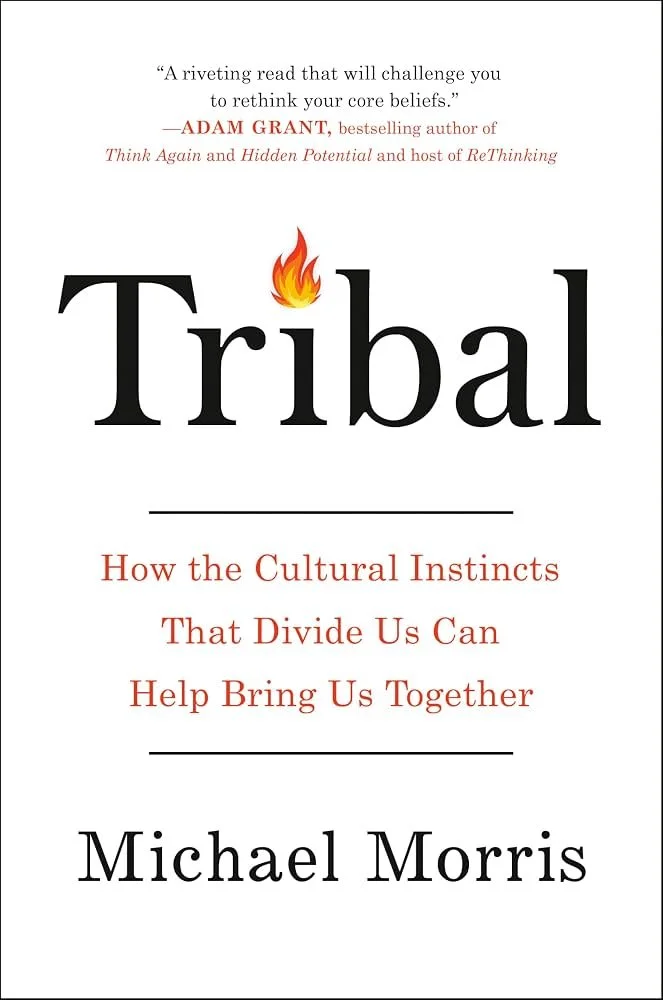
Every few years a book comes along that gives leaders a better language for something they already know is true but struggle to manage. Michael Morris's Tribal: How the Cultural Instincts That Divide Us Can Help Bring us Together, is one of those books. It is not a book about tribalism as a problem to be condemned from a distance. It is a book about culture as a living system: learned, cued, copied, protected, celebrated, and, with the right leadership, evolved.
That distinction matters enormously for leaders right now. Most organizations are not short on strategies, transformation roadmaps, or AI pilots. They are short on the shared energy and collective behaviors needed to turn those intentions into a better experience for customers and employees. Tribal helps explain why.
People do not change because a senior team issues a strategy memo or unveils a new organization structure. They change when the surrounding culture gives them new cues, shared stories, and reasons to believe that a different way of acting is now part of who we are.
That is why I see Tribal as an important contribution to a larger conversation I have been writing and speaking about under the banner of Leadership Experience. It applies more than ever as leaders navigate AI disruption, and look to build a culture of innovation, collaboration, and empowerment.
Leadership Experience (LX) is the multiplier that shapes both customer experience (CX) and employee experience (EX). Value = LX x (CX + EX). This is why culture eats strategy for breakfast. And why leaders that catalyze culture evolution have a transformative impact on their organization’s growth and the realization of its mission, vision, and purpose.
Leaders do not simply set direction. They create the conditions in which people decide what is safe, what is admired, what is remembered, and what is worth carrying forward. Morris gives us a powerful way to understand those conditions through three deep cultural instincts: the peer instinct, the hero instinct, and the ancestor instinct.
Let’s dive into the book together and examine how Morris’ ideas connect with others’ ideas that I’ve shared recently related to the topic of Leadership Experience.
Culture Is Not Fixed. It Is Cued.
Morris opens with a story that will resonate with anyone who has tried to change a team. Guus Hiddink, the Dutch coach brought in to lead South Korea’s national soccer team before the 2002 World Cup, did not treat Korean culture as a fixed constraint. He understood that cultural patterns are powerful, but also situational. People carry multiple codes inside them. Different settings, symbols, rituals, and expectations can bring different parts of identity to the surface, while also evolving the organization’s collective identity.
Hiddink created a new context in which South Korean soccer players could operate with more spontaneity, trust, and fluidity. He unlocked change by first changing the physical environment, bringing the team to train at an international facility. He challenged status patterns. He disrupted rituals that reinforced deference. For a while, the team began acting differently. Then the old habits returned. Veterans reasserted established routines. Younger players became hesitant again.
But Hiddink didn’t give up. And after months of reinforcement, interacting as equals became the norm for the Reds. The team went on to make the semi-finals, making for an electrifying World Cup for the host nation. Hiddink’s lesson was that culture has memory. New behavior must be reinforced long enough, vividly enough, and collectively enough to become sustained habits.
That is a crucial lesson for leaders. Too many change efforts treat culture as a set of values to announce. Morris shows that culture is more dynamic and more subtle than that. It lives in cues. It is activated by settings, language, attire, symbols, rituals, heroes, stories, and memories. A leader who wants to change culture must therefore become a designer of cues, not just a communicator of priorities.
The Three Tribal Instincts Leaders Need to Understand
The heart of Tribal is Morris’s model of three cultural instincts. The peer instinct draws us sideways, toward what people like us are doing. It helps us belong and coordinate, and results in diffusion of innovation. The hero instinct draws us upward, toward admired people and ideals. It fuels aspiration, contribution, and the desire to be worthy of esteem. The ancestor instinct draws us backward, toward inherited traditions and remembered ways of doing things. It gives continuity, meaning, and moral weight to behavior.
These instincts can divide us, but Morris’s more useful point is that they can also bring us together. The leadership challenge is not to suppress tribal energy. It is to channel it as a renewable source of energy for the organization’s change journey. The peer instinct can make a better behavior feel normal. The hero instinct can make that behavior feel admirable. The ancestor instinct can make it feel consistent with the organization’s deeper identity rather than a fad imposed by outsiders.
This is where Tribal is especially relevant for leadership experience. A leader is not merely a decision-maker. A leader is a change agent working within a cultural field. The best leaders know how to read the field before trying to reshape it. They understand what peers are copying, which heroes are being celebrated, and which stories from the past still define what the organization believes it is. Then they use that understanding to evolve the culture in ways that amplify the mission, vision, and purpose of the organization.
From Change Program to Change Journey
This is also where Tribal connects directly to the brand identify for JourneySpark. The name JourneySpark captures the work I believe matters most: helping spark ideas and energy on an organization’s change journey. The spark matters because people need a reason to move. The journey matters because culture does not transform in a single workshop, keynote, diagnostic, or offsite. It changes through repeated experience, shared interpretation, and visible commitment over time.
Morris’s examples reinforce this point. Some campaigns fail because they broadcast a message without creating a credible shift in what people see others doing. Others succeed because they build momentum in the right sequence: first making new habits visible, then elevating the people and ideals behind those habits, then embedding the change into shared rituals and institutional memory. In JourneySpark language, this is the difference between announcing change and engaging leaders together on their collective journey.
The collective part is essential. Leaders often want to cascade change before they have metabolized it themselves. They send the organization forward while the leadership team remains misaligned, ambivalent, or inconsistent. Tribal helps explain why that is so damaging. People watch leaders not only for instruction but for cultural signals. What leaders notice, repeat, reward, tolerate, celebrate, and remember becomes evidence of what the tribe truly values.
Peers: Making New Behaviors Feel Normal
The peer instinct is the most immediate and practical of the three. People constantly scan their environment for clues about what others like them do. That is why visible behavior often matters more than formal communication. If the official value is customer obsession but peers are rewarded for internal politics, the peer code wins. If the stated priority is experimentation but colleagues are punished for visible learning, the peer code wins. If the transformation language says empowerment but every decision is pulled back to the center, the peer code wins.
For leaders, the implication is simple but demanding: culture change must become observable. The new behavior has to show up in meetings, rituals, stories, metrics, and everyday language. It has to be seen in the behavior of peers, not only in executive speeches. When enough people begin to act differently in ways others can witness, a new pattern becomes easier to copy.
This is one of the reasons I have long argued that customer experience work cannot remain trapped inside a CX function. The organization needs shared behaviors that cross functions. The peer instinct explains why. People learn what matters not from an abstract customer promise but from the behavior of the people around them. The fastest way to make customer-driven behavior real is to make it socially visible and locally reinforced.
Heroes: Making the New Behavior Feel Worthy
The hero instinct adds a second layer. People do not only copy what is common. They also aspire toward what is admired. Every organization has heroes, whether officially named or quietly understood. They may be founders, product geniuses, store managers, engineers, or frontline associates. They embody the culture at its best.
Morris’s discussion of hero signals helps leaders see why storytelling is not a soft activity. Stories define what greatness looks like. They show who gets esteem and why.
Leadership experience, viewed through this lens, requires leaders to curate and model the right behaviors. Who gets recognized for making a customer’s life easier? Who is celebrated for simplifying work for employees? Who is admired for asking the uncomfortable question, surfacing the risk, or helping peers succeed? If heroes are chosen only for short-term financial performance, then the culture will learn that the mission and purpose are decorative. If heroes are chosen for behaviors that advance customer value, employee trust, and organizational purpose, then aspiration becomes aligned with strategy.
Ancestors: Making the New Behavior Feel Like Us
The ancestor instinct may be the most overlooked in corporate change. Leaders often frame transformation as a break from the past. Sometimes that is necessary, especially when a legacy behavior is causing harm. But Morris shows that people are deeply motivated by continuity. They want to know that change is not simply a repudiation of who they have been. They want to see how a new behavior connects to a deeper, more enduring identity.
This is why the best leaders do not only say, ‘We must become something new.’ They also say, ‘Here is what has always been best about us, and here is how we now need to express it differently.’ Mary Barra’s early work at GM is a good example. By simplifying a dress code into a broader principle of judgment, she was not merely changing attire. She was signaling a different relationship between rules, accountability, and ownership. LEGO’s turnaround story offers another example of tapping into a storied organization’s cultural legacy even as it charts a new path forward. The company returned to the essence of creative building while also discovering new ways to engage fans, learn from families, and extend the brand into digital and entertainment experiences.
That pattern is central to leadership experience. Cultures evolve most sustainably when leaders honor the best of the past while making room for the future. The ancestor instinct can become a brake on change when nostalgia hardens into resistance. But it can also become a bridge when leaders show that the next chapter is a faithful evolution of the organization’s mission, vision, and purpose.
Why This Matters Now: AI, Transformation, and Human Systems
Tribal is especially timely because AI is accelerating the pressure on organizations to change. Boards and CEOs are asking how AI will reshape operating models, customer experience, employee roles, knowledge work, marketing, service, and decision-making. Yet the central barrier is not the technology itself. The barrier is the human system: fear, status, identity, habits, incentives, stories, and trust.
Morris helps explain why AI cannot be managed as a technology rollout. People will ask peer questions: Who else is using this? Is it safe? They will ask hero questions: Who is admired for using AI well? What does great judgment look like now? They will ask ancestor questions: Does this violate what we believe about our craft, our customers, or our role in the world? Leaders who ignore these questions will get compliance at best and resistance at worst. Leaders who engage them can make AI a catalyst for better thinking, better collaboration, and better experiences.
Tribal connects with other books I’ve reviewed as part of the Leadership Experience conversation. Gerald Zaltman Zaltman, in Dare to Think Differently, reminds us that leaders must understand the hidden mental models beneath stated customer needs. Bernie Jaworski's The Soul of Strategy reminds us that purpose and value creation require deeper forms of customer insight and organizational imagination. Lou Carbone's experience engineering perspective, shared in Clued In, reminds us that the clues people encounter shape meaning and memory. Benjamin Granger's book, A Leader Worth Following, brings the discussion back to the leader’s own behavior. Michael Morris’ Tribal adds a vital cultural layer: people move when the tribe gives them signals that movement is normal, worthy, and continuous with who they are.
I’ve had Lou and Bernie on the podcast already, and have Gerald, Benjamin, and Michael coming up over the coming months.
I also recently had James Killian, Ph.D. and Simon Robinson back on the podcast to talk about our LX Accelerator (www.lxaccelerator.net). The LX Accelerator is a holistic system that aligns leaders and releases the energy of the “frozen middle” and frontline teams as leaders navigate AI disruption at their organizations. You can find a free cultural assessment on the site that takes just five minutes to complete, and you’ll get a PDF sent to you right away with your results.
A Hopeful Book for a Divided Time
The word tribal often carries a negative charge. We use it to describe polarization, exclusion, and conflict. Morris does not deny those dangers. But his book is ultimately hopeful. Human beings are tribal because we are meaning-seeking, learning, imitating, aspiring, remembering animals. The same instincts that divide us can help us build, adapt, and belong.
For leaders, that is both a responsibility and an opportunity. You cannot lead change by standing outside the culture and critiquing it. You must understand the tribe’s codes, honor what is worthy, challenge what is limiting, and create the experiences that help people move together. That is the deeper work of leadership experience.
Tribal is valuable because it reminds us that culture is not a mysterious force that happens to leaders. It is a living pattern leaders participate in and help evolve. The best leaders spark ideas and energy, but they also help people travel the journey together. They make the next right behavior feel normal through peers, admirable through heroes, and meaningful through ancestors. That is how cultures change. And that is how customer and employee experience become more than programs. They become lived experiences that inspire leaders on the change journeys for the organizations they lead.