
Obsessed
"Customer-driven leaders do not wait for disruption. They practice it as a discipline. They anticipate needs that have not yet been spoken. They embed data, empathy, and experimentation into their operating rhythm. They see technology (inclusive of Artificial Intelligence) not as a replacement for human judgement, but as an amplifier of human insight.”
–James Killian, PH.D.
The missing link between CX, EX, and leadership
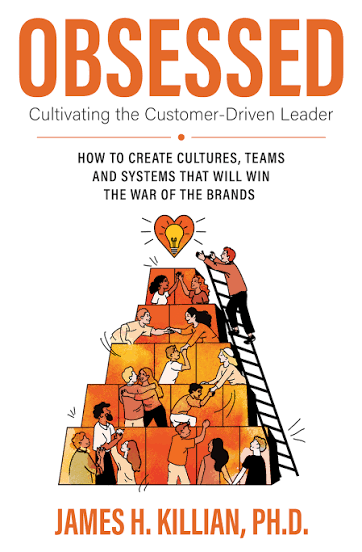
Customer-centricity is one of the most overused expressions in business. Many companies claim to put customers first. Far fewer have designed their leadership practices, metrics, incentives, policies, and daily workflows to deliver on that promise. That is what makes James Killian’s Obsessed such a timely and useful book. James takes a familiar aspiration and turns it into a practical leadership discipline.
I share James’ passion for how customer experience and culture go together. In my book and podcast, both called The CX & Culture Connection ®, I return to a simple premise: the experiences customers receive reflect the behaviors employees practice, and those behaviors are shaped by leaders. Those include both direct behaviors, where human-to-human experiences deliver your brand promise, as well as indirect behaviors where employees collaborate to design the products, services, digital experiences, physical environments, and business models that all contribute to customer value. James captures the connection especially well: customer experience is employee experience amplified at scale, with leadership acting as either a catalyst or derailing your progress on your change journey.
Lou Carbone, who introduced the term experience management in 1994 in his seminal work with Stephan Haekel, Engineering Customer Experiences, in the journal Marketing Management, wrote the foreword to James’ book. Lou has been a big influence on my own thinking (guest #5 on the CX & Culture Connection ® podcast), given his focus on how your brand is brought to life through all the experiences people have with it across countless clues that communicate whether the brand deserves trust. Lou later wrote Clued In, which focuses on how employee’s clue consciousness is critical to deliver emotionally engaging experiences along the customer journey. James adds an important, third lens to Lou’s fusion of customer and employee experience. He elevates the concept of leadership experience (LX) as a unique discipline alongside customer experience (CX) and employee experience (EX). As I’ll return to later, James’ focus on LX is one of the things that brought us together with Simon Robinson, another early pioneer in experience management who also calls out the importance of LX in his own excellent book, Designing Customer Experiences with Soul.
Four leadership profiles — and a mirror for every executive
The central framework in Obsessed distinguishes four patterns of leadership behavior: customer-avoidant, customer-tolerant, customer-centric, and customer-driven. They are not labels for good and bad people. They describe behavioral tendencies that are reinforced by organizational systems, especially under pressure. As leaders navigate AI disruption, this pressure is only getting stronger.
Customer-avoidant leaders become insular, defensive, and detached from emerging needs. James uses the companies Segway and Humane to show how innovation efforts fail when leaders stop inviting inconvenient evidence into the room. Customer-tolerant leaders may collect feedback but do little with it. They defend policies and celebrate dashboards while customers experience the same frustrations. Customer-avoidant and customer-tolerant leaders both exhibit what James calls derailing behaviors, the fundamental difference separating them from the other two types of leaders.
Customer-centric leaders listen deeply, empower teams, and make decisions based on what customers value. Customer-driven leaders go a step further: they anticipate needs and shape expectations through a continuous rhythm of empathy, insight, and experimentation. The distinction is not merely between serving customers well today and serving them better tomorrow. It is between reacting to the market and shaping the future.
The four profiles provide a language for honest self-reflection. Most leaders can recognize a little of themselves in more than one of the four leadership profiles. When companies engage a cross-section of leaders using our LX Accelerator tool there’s a curve distributed across the leadership profiles that spikes for one of them. The real test is what happens when budgets tighten, deadlines loom, or new technologies like AI challenge established habits. Under stress, do leaders become more curious and collaborative — or more controlling and defensive?
From listening to learning to action
One of the book’s most powerful insights is that collecting customer feedback is not the same as learning from it and acting on it. There’s often a gap between knowing and doing. James describes tolerant leaders who mistake surveys, dashboards, and software investments for genuine accountability. Their problem is not a lack of information. It is a lack of willingness and organizational capacity to change.
This connects to my podcast conversation with Katy Tynan, Principal Analyst at Forrester, about the tension between doing and learning cultures. It also reminds me of my podcast with Oded Netzer and Chris Frank, co-authors of Decisions Over Decimals, about making better decisions from imperfect data. The goal is not to chase scores or wait for the perfect data. It is to make better choices, faster, by combining evidence with human judgment.
James makes the ideas concrete through case studies, including T-Mobile’s “Un-carrier” reinvention and Singapore Airlines’ sustained investment in premium experiences through frontline empowerment and learning. Frontline teams cannot deliver a promise that the organization’s policies, incentives, and leaders make difficult to keep.
Leadership experience is the multiplier
This is where Obsessed intersects directly with the work James, Simon Robinson, and I are doing together on the LX Accelerator (www.lxaccelerator.net). Leadership experience amplifies the value of investments in customer and employee experience — or derails your change journey. We use a simple equation to make the point: Value = LX × (CX + EX).
The LX Accelerator is designed to close the gap between leadership intent and impact, including unlocking the energy of the “frozen middle” where even compelling strategies can lose momentum. We have built a free assessment tool that takes only five minutes and helps leaders reflect on their own leadership profile and on the cultural tensions at their organization among Better, Faster, and Cheaper. These are not abstract trade-offs. An organization that prizes perfection may struggle to experiment; one that prizes efficiency above all else may unintentionally undermine empathy and trust.
In his book, James describes an outside-in Customer-Driven Leader Algorithm that combines indicators of employee experience, customer experience, growth, and values. He uses this to score the companies he uses as examples in the chapters focused on each leadership profile. This is useful to illustrate why the companies profiled in the book land where they do. Our LX Accelerator provides a complementary inside-out approach that enables a richer discussion for the types of behaviors leaders engage in, as well as where to focus to manage tensions across Better, Faster, and Cheaper cultural traits. For example, you may have more of a Better culture today and aspire to reinforce Faster behaviors more as you embrace AI on your change journey.
In his book, James shares examples of the specific behaviors exhibited across the four leadership profiles. While Customer-driven leaders exhibit more Faster behaviors, that doesn’t mean that it is always the largest pole in the tent across Better, Faster, and Cheaper for every company. We are excited to conduct further research that explores the connections between the four leadership profiles and cultural traits across Better, Faster, and Cheaper, and how they support progress against desired business outcomes like innovation, quality, and loyalty that drive customer lifetime value.
Customer-driven leadership in the age of AI
The stakes are rising as generative and agentic AI reshape how work gets done. In our Cre(ai)tive Revolution article on Organizational Intelligence, my JourneySpark parter Randall Rothenberg and I argue that AI adoption requires more than another change program or technology rollout. Organizations need an enduring capability to sense, learn, experiment, and adapt — one that combines artificial intelligence with human judgment, creativity, empathy, and shared purpose.
Organizational Intelligence is built on three mutually reinforcing opportunities: reimagining workflows, reimagining insights, and reimagining learning and development. Each is visible in James’s framework. Customer-driven leaders redesign work around customer needs, convert data into decisions, and coach people to build better habits. They treat technology as an amplifier of human insight, not a substitute for it.
That last point is particularly important. Faster access to customer data does not automatically produce customer-driven behavior. AI can make it easier to detect signals and test alternatives, but leaders still must decide what to value, whom to empower, and which behaviors to reward. An organization can automate its existing dysfunction rather than build a learning culture.
A practical playbook, not another CX slogan
I appreciate that James does not stop with an appealing typology. The book provides practical actions and checklists for each leadership profile: walking the customer’s path, incorporating customer learning into executive goals, coaching specific behaviors, empowering cross-functional ownership, and reviewing whether the organization is slipping back into old habits.
I was honored to be one of 14 people for whom James included interview excerpts in the book, 5 of whom have been guests on my podcast. In his excerpt from our interview, I emphasized the importance of a balanced approach to drive change that harnesses the emotional energy of your people via your informal organization — how people work together and the networks they form matters — as much as formal structure. I learned from Jon Katzenbach that the informal organization fuels emotional connection, while the formal side drives rational compliance. Both are needed to drive sustainable change. The task is not to punish every bad habit. It is to amplify the good behaviors until they become the normal way work gets done. People act their way into new mindsets, not the other way around.
The examples in Obsessed are illuminating, though I would not treat every corporate turnaround or external leadership score as proof of causality. The book is most valuable as a diagnostic and a catalyst for conversation. Its central challenge is harder, and more useful, than any ranking: what are we doing every day that makes customer-driven behavior easier or harder?
Where to begin
I encourage leaders to read and talk about Obsessed with their teams, not simply add it to their own personal bookshelf. Explore which of the four profiles best describes your organization today, where you revert under pressure, and which specific habits would most improve the experiences of employees and customers.
You can also take it a step further by engaging your teams in a discussion of LX Accelerator results with James, Simon, and me. This will help you put these ideas into practice, combining leadership self-awareness, cultural alignment, and practical habit building. You can start with our free, 5-minute assessment at https://www.lxaccelerator.net/ and receive a personalized culture report immediately afterwards. If this resonates with you, we can also talk about how to apply this with your team.
The future of customer obsession will not be won by the companies that talk about it most, or even those that deploy the most AI. It will be won by organizations whose leaders create the conditions for people to listen, learn, experiment, and act — consistently, at scale. As James puts it, the war of the brands will be won by customer-driven leaders that shape the future, not those that react to it.
If this review sparked your interest, you may also find my discussion with James and Simon on the CX & Culture Connection ® podcast worth a listen.
You may also enjoy the following other books I’ve reviewed from recent podcast guests that focus on leadership and how to foster the right behaviors that drive greater organizational effectiveness.
· A Leader Worth Following, by Benjamin Granger
· Dare to Think Differently, by Gerald Zaltman
· The Soul of Strategy, by Bernie Jaworski
I’m looking forward to hearing from you as you continue your own change journey as a leader!