
Experience is Everything
"Even if you take tools such as journey mapping or voice of the customer, collect all the feedback, and investigate and find the data, the only way you can really take action is if there is cultural commitment in your organization."
–Jeannie Walters
There is a dangerous assumption spreading through many organizations right now. The assumption is that customer experience transformation, catalyzed by rapid advancements in AI, is primarily a technology problem.
Reduce call volume by implementing AI chatbots. Personalize interactions with customers Orchestrate the customer journey across touchpoints. Collect more feedback and mine unstructured data signals. Build better dashboards.
Problem solved. Except it isn't.
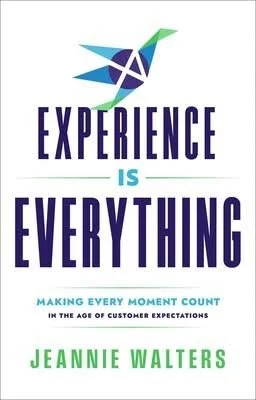
That is why Jeannie Walters' new book, Experience Is Everything, resonates with me.
At a moment when organizations are racing to deploy AI, automate workflows, and modernize customer engagement, Walters reminds us of something deceptively simple: customer experience is ultimately a human commitment. And without focus on how CX and culture go together, even the best tools become disconnected activities.
This core idea in Jeannie’s book reminded me of other books I've reviewed recently, including Benjamin Granger's A Leader Worth Following, Bernie Jaworski's The Soul of Strategy, Gerald Zaltman's Dare to Think Differently, and Simon Robinson's Designing Customer Experiences with Soul. In addition to writing reviews of their books, I’ve also had Bernie and Simon on my podcast, The CX & Culture Connection, and have episodes with Benjamin, Gerald and Jeannie scheduled over the next couple of months.
Experience Is Everything, like these other books, connects directly to my interest in Leadership Experience (LX). As James Killian, Ph.D., Simon Robinson, and I have focused on through our LX Accelerator (www.lxaccelerator.net), organizations often invest in customer experience (CX) and employee experience (EX) as a set of siloed initiatives, while overlooking the force that connects them and amplifies both CX and EX: Leadership Experience (LX). James, Simon, and I summarize this relationship through a simple equation:
Value = LX × (CX + EX)
Leadership is the multiplier. When leadership is weak, even the best CX initiatives fall short. When leadership is strong, customer-centric behaviors become habits. Habits influence cultural evolution. Culture becomes competitive advantage.
One of the strongest ideas in Jeannie’s book is her emphasis on creating a Customer Experience Mission Statement. Too often organizations launch customer initiatives without a shared belief system for what experience they are trying to create or why it matters.
Without a clear mission, everything feels disconnected. There is no purpose. These is no emotional attachment by customers and employees. As both Simon and Bernie emphasize in the titles of their own books, there is no soul.
The result is a collection of projects rather than a strategy.
Jeannie offers four deceptively simple questions:
What is our brand promise?
What's in it for the customer?
What experience can we consistently deliver?
What do we want customers to feel?
That final question is where the book shines.
Many organizations remain trapped in a functional mindset. They focus on products, processes, efficiency, and transactions.
Jeannie redirects our attention toward emotion. As Jeannie writes, customers are trying to accomplish something meaningful in their lives. They want experiences that help them achieve their goals in ways that are easier, more convenient, and more delightful.
That idea connects to the ideas in my own book and podcast, which are both called the The CX & Culture Connection. The peaks in your customer journey are where they are most meaningful and memorable. Emotions are key to creating a loyalty loop, which are behavioral habits where customers crave emotions. Habitual behaviors by your employees are key to amplifying existing peaks and introducing new peaks in the customer journey.
The "C" in the CULTURE acronym around which the chapters in my book are organized stands for creating emotionally engaging customer experiences. The "L" stands for looking ahead and imagining the experience you want customers to have.
A CX mission statement is the bridge between the two. It helps leaders articulate the future experience they want to create and align the organization around delivering it consistently. Jeannie is right to emphasize the value of starting there.
Experience is not simply the functional benefits of a product or service. Experience is what customers remember. Meaning is what customers share. And community is when sharing amplifies meaning.
As I read Jeannie’s book, I found myself thinking about the Experience Collage framework in my own book. Experiences are built through many interconnected moments. Just as every piece of a collage contributes to the larger picture, every interaction contributes to how customers create meaning and community around your brand.
You may have seen the artwork on my book’s cover, on JourneySpark’s website, or at the intro and outro to my podcast. It is a collage series from my mom called Emotion Motion, that is a deconstructed customer journey in mixed media, combining collage with painting. Here’s a link to more information on the Emotion Motion series.
One of my favorite sections of Jeannie’s book centers on her use of the paper crane as a symbol for customer experience. Inspired by the Japanese tradition where paper cranes represent hope, healing, and peace, the crane becomes a metaphor for the combination of mindset, strategy, and discipline required to deliver meaningful experiences.
Every fold represents a choice: to listen, to care, to serve, and to make experiences more human.
That human-centered mindset is increasingly important as AI becomes more prevalent.
Throughout the book, Jeannie warns readers not to become distracted by technology. AI can accelerate journey mapping. It can identify patterns. It can help personalize interactions. But AI cannot decide what matters.
Leaders must do that.
Throughout the book, Jeannie emphasizes mindsets and behaviors. Organizations do not change because people think differently. Organizations change because people behave differently.
This is where the book connects beautifully to Granger's work in A Leader Worth Following and Jaworski's work in The Soul of Strategy. Both emphasize that culture is ultimately behavioral: curiosity, listening, empathy, experimentation, and open-mindedness.
Customer-centricity becomes real when leaders align on the right set of behaviors and they are reinforced repeatedly through leadership actions, onboarding, storytelling, recognition programs, coaching, rituals, performance management, among other formal and informal catalysts for reinforcing cultural norms.
Jeannie reinforces these themes throughout her book.
Her discussion of Mission Moments was one of my favorite examples. Mission Moments encourage organizations to bring customer-centric stories into interviews, onboarding, team meetings, recognition programs, and daily work rituals.
This is exactly how cultures are built. Not through posters or slogans. Through repetition, stories, and ultimately habits. This is the essence of Leadership Experience. Another concept I appreciated was Jeannie’s Four Cs of Customer-Centric Culture: Conscience, Communication, Consistency, and Credibility.
Employees quickly recognize whether leaders truly believe what they say. If leaders talk about customer experience but reward conflicting behaviors, credibility evaporates. If leaders consistently reinforce mission-driven actions, credibility grows.
Trust follows. And trust becomes the foundation for customer-driven culture.
That is why Experience Is Everything ultimately transcends customer experience. It is a book for leaders looking to create customer-driven cultures, align teams around a shared purpose, and transform customer experience from a collection of initiatives into a strategic capability,
I am excited to continue the conversation when Jeannie joins me later this summer on The CX & Culture Connection podcast. In the meantime, I would place Experience Is Everything alongside A Leader Worth Following, The Soul of Strategy, Dare to Think Differently, and Designing Customer Experiences with Soul as essential reading for leaders navigating the intersection of customer experience, culture, and organizational transformation.
Because the deeper lesson is not really about customer experience. It is about leadership experience. And that is precisely why James Killian, Simon Robinson, and I are teaming on the LX Accelerator (www.lxaccelerator.net).