
Wayfinding
"The best Al strategies don't engage in a race to the bottom on headcount reduction and cost-cutting (even if they incorporate those elements) but instead reimagine business models and create new value streams with Al."
- Stephen Straus and Ben Szuhaj
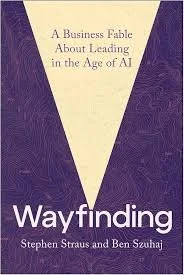
The pressure on executives to have an AI strategy is extraordinary. Boards want answers, competitors announce breakthroughs and deals, and employees wonder what automation means for their jobs. Yet the most important question may not be which AI tools to deploy or what solutions companies can build that are trained on their proprietary data. It is whether leaders create an organization capable of learning fast enough to turn technological disruption into business value.
That is the central insight in Wayfinding, a business fable by Stephen Straus and Ben Szuhaj. The book dramatizes the challenge of leading when the playbook is still being written. Its protagonist, Sarah, a logistics CEO under pressure from her board to develop an AI strategy, must unlearn the idea that good leadership means mastering every detail before taking action. I won’t retell her hero’s journey, as you’ll enjoy following it in the book. Rather, I’ll focus on what the story reveals about the leadership habits that enable—or undermine—AI-enabled change journeys.
From a doing culture to a learning culture
The book contrasts leaders who are eager to claim AI progress with those who solve actual business problems. One executive announces flashy AI pilots even when the outputs undermine customer trust. Another starts with employees’ frustrations, “plants the tree” early for data quality, and keeps human judgment in the loop. The latter approach is less theatrical, but far more valuable.
This distinction connects directly to my recent podcast conversation with Katy Tynan principal analyst at Forrester, about the tension between learning and doing cultures. Traditional management systems reward execution against known objectives. AI creates a different challenge: objectives, workflows, and capabilities are changing as we learn. Leaders need to make it safe to say “I don’t know,” challenge assumptions, share mistakes, and revise direction without treating every adjustment as failure.
Psychological safety and cultural behaviors that reinforce open-mindedness matter but are not a substitute for accountability. The test is whether people use what they learn to improve customer outcomes and business performance.
Invest in the organization, not just the technology
Straus and Szuhaj make an important distinction between direct investments in AI tools and technology-enabled solutions and the enabling investments in data, talent, workflows, and culture that make those solutions valuable. Many organizations fund AI pilots while treating the work of changing behaviors as a secondary implementation task. This is a key cause of the high failure rate for AI pilots.
In our Cre(ai)tive Revolution Substack article on the Orchestration Imperative, Randall Rothenberg and I describe the change journey of a consumer entertainment client of JourneySpark whose ambitious AI-enabled transformation stalled despite strong digital capabilities and a customer-obsessed culture. The solution was not changes to the technology roadmap. It required listening to employees, redesigning workflows with them, clarifying leadership expectations, and building a practical system of change. People embrace what they help create.
This is why I increasingly think in terms of Organizational Intelligence: an enduring capability to sense, understand, and accelerate adaptation. In another Cre(ai)tive Revolution article, we explore three mutually reinforcing areas for reinvention —workflows, insights, and learning and development. AI can enhance all three, but only if leaders connect them in a continuous learning loop instead of treating adoption as a sequence of isolated projects. Organizational Intelligence is the fusion of AI with human empathy, creativity, and expertise.
Here’s the link to the other Substack article: Organizational Intelligence: Building an Adaptive Organization for the Age of AI
I was impressed by Straus and Szuhaj’s own focus on culture and organizational change in their business fable, which is based on a distillation of their experience at Kungfu.ai.
Better, faster, and cheaper—managing cultural tensions
One of the book’s strongest arguments is that an AI strategy built only on headcount reduction and cost savings is dangerously narrow. It may improve existing processes while missing opportunities to change the basis of competition. The more compelling question is how AI can create better experiences, new services, and new sources of value—not merely deliver your current business model at lower cost.
That resonates with our own work at JourneySpark connecting customer experience (CX), employee experience (EX), and leadership experience (LX). In Wayfinding, the promising use cases do not remove employees from the equation. They augment expertise, help people concentrate on higher-value judgments, and make services more resilient for customers. Data from operations and customer feedback become strategic assets rather than merely inputs for reporting.
All cultures combine a unique blend of behaviors that deliver better, faster, and cheaper benefits aligned to the organization’s mission, vision, purpose, and values. Leaders need to align on which outcomes matter most and where trade-offs are acceptable. The right answer varies based on the organization’s brand promise and operating model. Faster and cheaper can be powerful; neither compensates for damaging the experience that differentiates a brand. Every culture has a unique combination of all three, even if one of them plays a more prominent role in delivering on the brand promise. Even if you aspire to be more of a faster culture, there are some behaviors for better and cheaper that are still valuable and help define your brand.
The business fable in Wayfinding does an excellent job of illustrating these cultural tensions through the journey that Sarah, the fictional CEO at FreightCo goes on with others on her leadership team, as well as how she engages with her board. It does an excellent job of illustrating how LX amplifies value from CX and EX.
Why the author’s Wayfinding method resonates
Based on their experience at Kungfu.ai, Wayfinding gives useful structure to the messy early stages of AI-enabled innovation: defining hypotheses, exploring data readiness, validating the solution, and moving through technical and business proofs of concept. Their emphasis on disciplined discovery is a welcome counterweight to the pressure to move fast and break things popularized by tech startup cultures.
The authors don’t treat their Wayfinding methodology as a wholesale replacement for agile, but as a variant of it. In my experience co-founding Booz Digital (which I carried through in my subsequent work at PwC and later when I founded Journeyspark) we learned to bring strategy, technology, analytics, and experience design together, and to spend enough time defining a real, achievable minimum valuable product (MVP). As the authors so eloquently illustrate in Wayfinding, the distinctive challenge with AI is that probabilistic behavior and the quality of underlying data make those early learning loops even more consequential.
A strategy can also be sound at the top and stall in the middle, where incentives, habits, and competing priorities shape daily decisions. That is why I put so much emphasis on leadership experience (LX): helping leaders translate strategic ambition into the conditions their teams need to succeed. My review of Obsessed by James Killian, Ph.D., which shares lessons from his research into Customer-Driven leadership, makes a related point: leaders that shape the future rather than just react to customer pressures create the most value from continuous innovation in products, services, and business models. In Wayfinding, the strategy that Sarah develops with her team to share with her board shows what it means to be a Customer-Driven leader.
The leadership journey in an age without maps
Perhaps the most memorable lesson in Wayfinding is the shift from the leader as expert to the leader as learner. Executives have spent careers developing judgment and earning credibility by knowing the answers. AI challenges a leader’s identity and perception of their strengths. The strongest leaders do not abdicate their own or their teams’ judgment to machines, but neither do they pretend they can personally master every technical detail. They build multidisciplinary teams, invite challenge, foster learning cultures, and connect experimentation to enterprise value.
That theme also runs through my recent podcast discussion with Benjamin Granger, best-selling author of A Leader Worth Following, on how leaders shape behavior through the cues, role models, and social norms they reinforce. Culture is not an abstract statement on a wall. It shows up in who gets heard, which behaviors are rewarded, and how leaders respond when experiments disappoint.
Wayfinding is an accessible and worthwhile read for leaders who feel the pressure to move on AI but suspect that more pilots alone will not solve their business problems. Its fable simplifies some of the messiness of real organizational politics, and the Wayfinding methodology shared in the book is best viewed as a practical guide rather than a universal formula. But the larger message is exactly right: enduring advantage comes from combining technological capability with human judgment, trust, and the capacity to learn.
This review is part of an ongoing series of book reviews and podcast conversations exploring how leadership and Organizational Intelligence can help leaders and their organizations navigate AI disruption. I look forward to exploring these ideas with Stephen and Ben on an upcoming episode of The CX & Culture Connection.
I hope this sparks some great ideas for you and energy to act!