
The Experience Performance System
"We’re not here to improve dashboards. We’re here to rewire how companies work. That requires a different kind of CX leader. One who doesn’t wait for buy-in but earns it. One who doesn’t chase sentiment but moves strategy. One who builds a system, earns influence, drives alignment, and delivers outcomes."
–Zack Hamilton
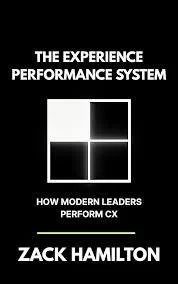
Experience Management (XM) has reached a pivotal moment. Even as organizations shift their focus from “insights theater” to driving business outcomes, agentic AI enables them to shift the curve for a broad range of efficiency and effectiveness use cases across marketing, sales, and service.
In The Experience Performance System, Zack Hamilton offers one of the clearest and most actionable answers to this challenge. He moves XM out of the realm of dashboards and into the core of the business—connecting insights to business outcomes, embedding accountability, and enabling teams to act with speed and confidence.
Zack’s Experience Performance System (EPS) provides a 12-step capability maturity framework to help organization’s make the shift from insights theater to scalable results. The book lays out a roadmap for how CX leaders can become change agents within their organizations, including relevant stories for how to apply each of the 12 steps for EPS.
In the book, Zack positions agentic AI as the12th building block for EPS. While I agree that the first 11 steps lay the groundwork for a more scalable and holistic approach to agentic AI, companies can capture significant value by adopting agentic workflows immediately as part of their change roadmaps. Organizations can use AI to capture enormous time savings that can be reinvested in ways that boost the pride of employees for the outcomes they help drive. Today, as organizations design and optimize agentic workflows across marketing, sales, and service, they can reimagine the work of teams, prioritize frictions to address in agile delivery pods, and create a learning organization that applies these insights across an expanding set of use cases over time.
Done right, this does more than save time and drain the pain across the customer journey. It enables closer alignment between your CX and brand promise, designing the moments that define a brand—the emotionally resonant peaks that go beyond the functional benefits of a product or service to create an emotional connection with customers through meaning, sharing, and community.
The bottom line: Zack has provided a blueprint that leaders can embrace to drive adoption of the right behaviors within the organization. The organizations that win will be those that build the muscle to operate in continuous loops, embedding experience into decision-making and catalyzing an organization-wide cultural movement.
From Insights Theater to Performance Reality
Zack calls out what many leaders feel but rarely say out loud: most CX programs are still “insights theater.” CX teams often reflect, report, and route feedback. But, too often, they don’t take ownership for outcomes metrics tied to resolution of frictions across the customer journey. EPS reframes CX from a listening discipline into a performance system—one that connects friction to the P&L, prioritizes what matters, and drives action with accountability. Insights are not impact. Measurement isn’t execution. Sentiment is not strategy. EPS operationalizes that truth.
CX That Works Like a Business
What makes EPS compelling is not just the critique—it’s the actionable set of recommendations for how to build a scalable system.
Here are the 12 complementary modules in EPS:
The Signal Model, integrating data signals across customer and employee listening, behavioral and operational data
The Friction Model, categorizing and prioritizing frictions based on connection to business outcomes
The CaseMaker Model, 1-page business cases that clarify the cost of not acting
The Champion Model, illustrating how to drive executive support to influence, mobilize, and drive outcomes
The Close Plan Model, outlining milestones, blockers, decision makers, and proof needed to move from idea to action
The Prioritization Model, solving the highest value frictions first
The Pod Model, standing up agile journey pods to work on opportunities
The Scaling Model, shifting from XM as a department to distributed performance
The Influence Model, mapping power structures, engaging champions, and driving cross-functional alignment through trust and shared wins
The Feedback Loop Model, embedding signals into a continuous loop
The Employee Signal Model, connecting frontline feedback to operational friction
The Agentic Model, powering data-driven orchestration to drive performance at scale without humans guiding every step
EPS doesn’t ask the organization to become more customer-driven in theory. It shows how to embed CX into the fabric for how decisions are made across the business, and how to scale cross-functional collaboration through a repeatable playbook.
From Programs to Movements
The most important idea in EPS isn’t these 12 models. It’s a mindset. You’re not building a program. You are building a movement. Journey pods replace committees. CaseMakers replace decks. Champions replace escalation. And most importantly: velocity replaces theater. One pod proves value. Many pods create a system. This is CX as an operating system—not a reporting layer.
EPS Aligns with the Future of CX
EPS is in tune with a broader shift happening across marketing, sales, and service: From break-fix → to system design From outputs → to outcomes From campaigns → to continuous loops In my own book, The CX & Culture Connection, and on my podcast by the same name, I describe CX as a system of behaviors that compounds over time. EPS reinforces that idea. Culture doesn’t scale through messaging. It scales through operating rhythms and specific behaviors across your leaders, managers, and frontline employees. This is something that I’m collaborating on with my colleagues James Killian and Simon Robinson. Go to www.laaccelerator.net for more on our LX Accelerator, which focuses on leadership experience (LX) as a force multiplier for customer experience (CX) and employee experience (EX). The equation for value is Value = LX x (CX + EX).
The Agentic Opportunity: Build Now, Not Later
One of the most exciting threads in the book is the move toward agentic systems—CX that doesn’t just observe, but acts. The best CX systems look and act more like intelligent operators than passive dashboards. That future is already here. EPS provides the operating system. Agentic AI can accelerate the loop—detecting friction faster, prioritizing dynamically, and in some cases resolving issues autonomously. The organizations that win won’t wait for perfect systems. They’ll start building muscle now.
Final Thoughts
The Experience Performance System is one of the most practical and important contributions to modern CX in recent years. It doesn’t just diagnose what’s broken. It shows how to fix it. But more importantly, it challenges leaders to rethink their role. Not as observers of experience. But as builders of systems that deliver it. Because in the end, the winners won’t be the companies with the best dashboards. They’ll be the ones with the best agentic systems.
Be sure to keep an eye out for my podcast with Zack that will drop in the next few weeks. I’ll post reels from the episode on LinkedIn and YouTube. Be sure to like and subscribe to the podcast on your preferred platform. You can also find episodes at www.cxandcultureconnection.com.