
Hidden Potential
“Collective intelligence rises as team members recognize one another's strengths, develop strategies for leveraging them, and motivate one another to align their efforts in pursuit of a shared purpose. Unleashing hidden potential is about more than having the best pieces – it's about having the best”
–Adam Grant
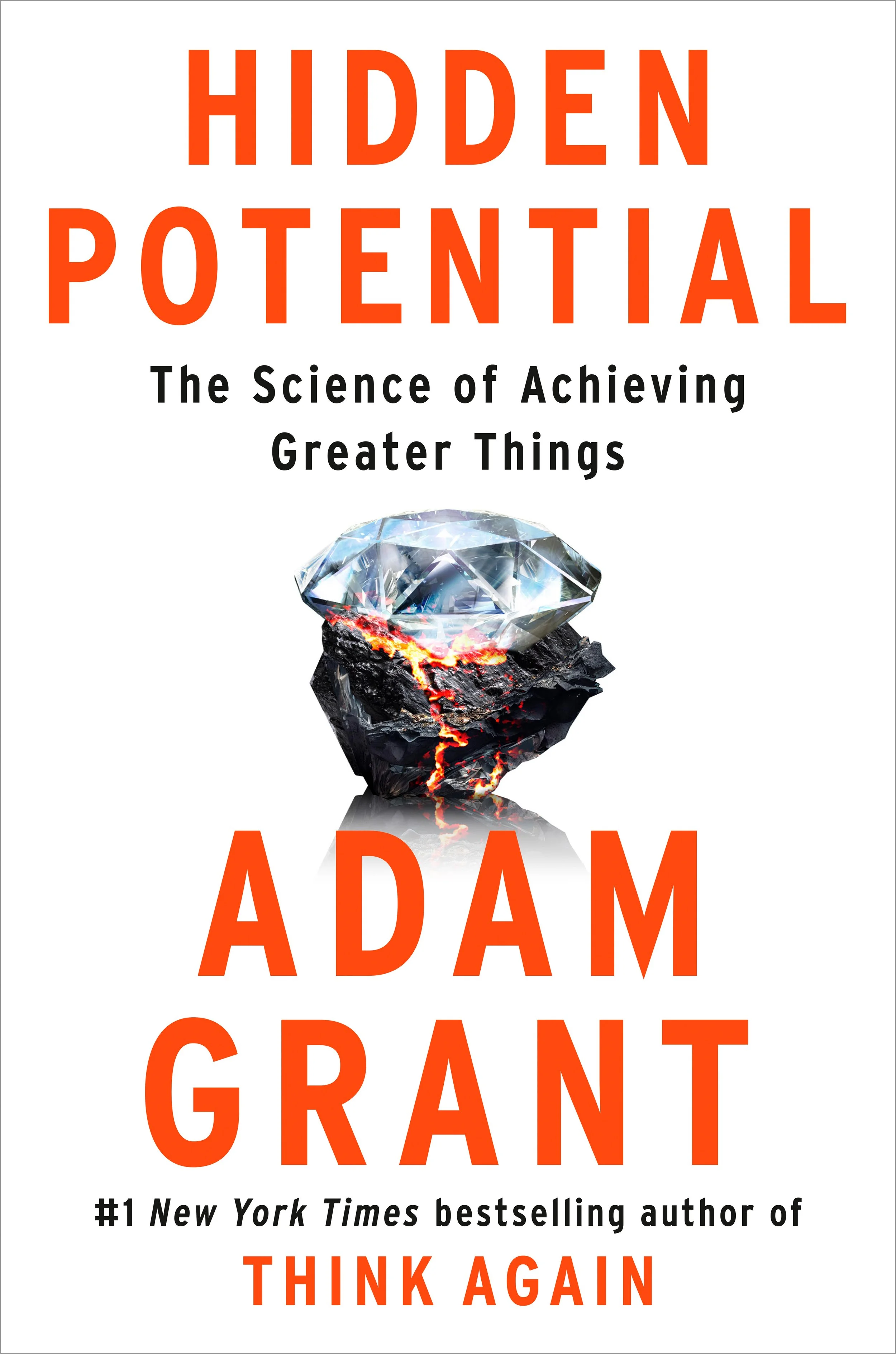
Professor Adam Grant's earlier book, Think Again, focused on an idea that has become even more important in the age of AI: our ability to reconsider what we believe, unlearn what no longer serves us, and keep experimenting is a cultural strength and source of competitive advantage. Hidden Potential, Grant’s latest book, builds on this powerful idea, focusing on how individuals and organizations can maximize their growth potential through more effective learning journeys.
Grant’s central argument is deceptively simple. We are too quick to judge people by where they start on their journey. Potential is better revealed by the distance someone has traveled — and by the character skills, motivation, and relationships that helped guide them. That idea has profound implications for how leaders build culture and how organizations navigate AI disruption.
This is where Hidden Potential connects powerfully to themes which I have been exploring recently about Organizational Intelligence. The brands that win will not simply be the ones with the best AI tools, but the ones that combine AI with human judgement, empathy, creativity, and shared purpose. They will be the ones that create the strongest learning systems: sensing what is changing, drawing out intelligence from across the organization, translating insight into action, and continuously adapting. Grant’s book helps explain the human and cultural foundation required to make learning systems work.
Potential Is a Journey, Not a Starting Point
Grant opens Hidden Potential with the Raging Rooks, a chess team of eighth- and ninth-graders from a public middle school in Harlem. They were not selected because they looked like chess prodigies. Their coach, Maurice Ashley, believed that talent can be found in many places. The team ultimately tied for first at nationals. The story sets up one of the book’s most important themes: if we judge people primarily by what they can do on day one, we will systematically miss what they can become.
That theme resonated personally with me. In my first year in middle school, I lost every one of my wrestling matches. By my junior year of high school, I won the NJ prep state championship at 189 pounds. I did not suddenly discover a hidden reservoir of natural wrestling talent. I trained harder, learned from my coach and teammates, and was motivated by seeing my own progress. Looking back, the journey mattered as much as the destination. It taught me that our starting point is a poor predictor of how far we can travel when motivation, learning, support, and practice amplify our progress on our journey.
Grant shares similar, personal stories of his own growth. He went from being one of the worst divers at his school to ranking among the best in the country. He also went from bombing at small lectures to being one of most in-demand professors and public speakers.
Grant makes a useful distinction between ambition — the outcome you want to achieve — and aspiration — the person you hope to become. That distinction is especially relevant for leaders today. Organizations are setting ambitious AI targets: better customer experiences, faster innovation, and higher employee productivity. But the more important question may be aspirational: what kind of culture do we need to build to realize those outcomes repeatedly?
Character Is Built Through Behavior
One of my favorite ideas in Hidden Potential is Grant’s reframing of character. We often treat qualities such as proactivity, discipline, determination, curiosity, and collaboration as fixed traits. Grant presents evidence that they can be reinforced as habitual behaviors.
This connects directly to our work at JourneySpark and the conversations on my podcast, The CX & Culture Connection ®. Culture is not simply a set of values on a wall. Culture shows up in what people repeatedly do — how they make decisions, collaborate, listen, experiment, serve customers, coach others, and respond when things go wrong. If we want to evolve culture, we need to identify the behaviors that bring our strategy and values to life and then build the conditions that make those behaviors regular habits.
Grant cites an experiment with entrepreneurs in West Africa in which training focused on personal initiative — qualities such as proactivity, discipline, and determination — yielded substantially greater profit growth than conventional business-skills training. The broader lesson is important. Technical and cognitive skills matter, but in an AI-enabled workplace, they are increasingly complemented by the distinctly human capabilities that determine whether people learn, collaborate, exercise judgment, and act.
This is also why I believe AI adoption is fundamentally a culture and change challenge, not just a technology rollout. Employees do not become effective users of AI because they attend a course on prompting. They improve when they are encouraged to experiment, given permission to be uncomfortable, coached on what good looks like, and exposed to useful examples. The same is true for teams collaborating on creating new workflows, and for employees adopting AI tools that the organization either builds or buys to power those workflows.
From Think Again to Learn Again
Think Again emphasized the importance of building mental muscles for reconsideration. Hidden Potential adds another layer: improving depends on the quality of what we absorb and our ability to put it to use. Grant calls this absorptive capacity — recognizing, valuing, assimilating, and applying new information. That is an individual skill, but it is also an organizational capability.
This is where the connection to Organizational Intelligence becomes especially strong. AI lowers the cost of connecting signals, knowledge, people, and action across organizational silos. The opportunity is not simply to create more information. It is to build a continuous learning loop: sense what is happening, interpret it from multiple perspectives, translate it into better decisions, learn from the results, and feed that learning back into the next cycle.
Grant’s “sponge” metaphor is useful here. Organizations can suffer from the same failure modes as individuals. They can be reactive rather than proactive. They can seek information that confirms what leaders already believe. They can collect more data without improving their capacity to learn from it. Organizational Intelligence therefore requires more than technology. It requires curiosity, psychological safety, strong listening behaviors, cross-functional collaboration, and leaders who reward learning rather than certainty.
Embrace Discomfort — and Imperfection
Grant argues that accelerated learning requires discomfort: abandoning methods that have worked before, trying new skills before we feel ready, and being willing to make mistakes. That is an uncomfortable message for organizations that have spent decades rewarding expertise, predictability, and polished execution.
AI makes this tension unavoidable. The practices that made someone successful in the past may not be the practices that make them successful in the future. A culture that punishes visible learning will slow adoption because people will wait until they feel competent before experimenting. A culture that treats thoughtful experimentation as part of the job will enable their organization's to move much faster.
Grant’s discussion of perfectionism is particularly relevant. High standards can fuel growth; perfectionism can prevent it. Perfectionists spend too much energy on details that do not matter, avoid unfamiliar situations where they might fail, and punish themselves for mistakes. Grant invokes the Japanese ideal of wabi-sabi — appreciating imperfection — which connects naturally to MVP thinking and lean startup practices. Organizations need the discipline to distinguish between places where perfection is essential and places where a fast, imperfect experiment is the better path to learning.
That does not mean lowering standards. It means shifting from proving that we are right to learning how to get better.
Scaffolding: Why Leadership Experience Matters
Hidden Potential is not a celebration of rugged individualism. Grant shows how growth depends on scaffolding: the support structures provided by coaches, teachers, mentors, peers, and role models that help us reach places we could not reach on our own.
This is where I see a direct connection to Leadership Experience (LX). I have been working with James Killian, Ph.D. and Simon Robinson through our LX Accelerator on the idea that leadership experience (LX) deserves to be treated distinctly from employee experience (EX) and customer experience (CX). How leaders experience their role — and how intentionally they show up — shapes the conditions everyone else experiences. Leaders help motivate and tap into the energy of the frozen middle. They help empower and energize frontline employees to work together in service of the organization’s mission, vision, and purpose.
A strong leader creates scaffolding. They clarify the strategy. They make it safe to learn. They coach rather than simply criticize or cheerlead. They give people room to stretch at the edge of their abilities. They recognize progress. They connect people to one another.
That is why LX acts as a multiplier for CX and EX. Leaders create the environment in which employee potential is either unlocked or suppressed. Employee behavior, in turn, shapes the customer experience. Culture is the connective tissue between all three.
Make Practice Feel More Like Play
Another theme I enjoyed is Grant’s focus on deliberate play. We have been taught to associate mastery with grinding through thousands of hours of repetitive practice. Grant’s point is more nuanced: practice needs clear goals and feedback, and sustained growth depends on maintaining joy and intrinsic motivation.
This reminded me of my recent book review and podcast conversation with Professor Gerald Zaltman, whose book Dare to Think Differently focuses on “serious play” as an important leadership behavior. Play is not the opposite of serious work. At its best, it fosters the curiosity, experimentation, and freedom from ego that make better thinking possible.
That matters for organizational change. Too many transformation programs feel like obligation layered on top of already-full jobs. AI adoption becomes another training module, another mandate, another metric. Grant’s distinction between superficial gamification and deliberate play is useful: the answer is not adding points and badges to tedious work. It is redesigning the work of learning so that it is inherently more engaging and developmental. This is a focus of our work at JourneySpark, helping clients build Organizational Intelligence and cultural movements, including reimagining three core enablers: workflows, insights, and learning and development.
The Best Glue, Not Just the Best Pieces
The final section of Hidden Potential may be the most important for leaders. Grant moves from individual character and motivation to systems of opportunity. His argument is that organizations should not simply search for stars. They should create systems that help more people develop and contribute.
The smartest team is not necessarily the team with the smartest individuals. What matters is whether people recognize one another’s strengths, listen, contribute, coordinate, and align around a meaningful shared purpose. The organization’s potential is not simply stored inside individual people. It emerges through the relationships between them.
This has clear parallels to Professor Michael Morris' book Tribal, which I recently reviewed, and then discussed with him on my podcast (see episode 89 here). Morris shows how our peer, hero, and ancestor instincts shape culture and prosocial behavior. Grant arrives at a related conclusion from a different direction: groups become smarter when people recognize their interdependence and lift one another up around a shared mission.
The Hidden Potential of the Organization
Every company has intelligence it is failing to use. It sits in frontline observations that never reach leadership, customer signals trapped in functional siloes, ideas that die because the wrong person said no, lessons from experiments that are never scaled, and employees whose capabilities are underestimated because of where they started.
AI can help us find and connect more of that intelligence. But it cannot substitute for the culture required to amplify it.
That is the opportunity in front of leaders. Build organizations where people are expected to learn rather than merely know; where coaches help people stretch rather than criticize their shortcomings; where experimentation is disciplined but imperfection is beautiful; where intelligence flows across silos; where progress amplifies energy; and where leaders measure potential by how far people and teams can travel.
Think Again encouraged us to reconsider what we know. Hidden Potential challenges us to reconsider what people — and organizations — can become.
In an era obsessed with artificial intelligence, that may be one of the most important forms of intelligence for leaders to cultivate.