
Revenue Operations
“The emergence of advanced analytics, Al, and Machine Learning (ML) - and the massive new sales engagement data sets to support them - represent the most significant opportunity to accelerate sales growth since the scale adoption of call centers (40 years ago), CRM (30 years ago), and digital channels (20 years ago).”
–Stephen Diorio and Chris Hummell
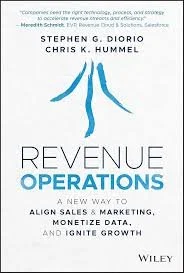
Why do so many companies suffer from slower organic growth? Often, the core issue is that Marketing, Sales, and Service operate in siloes, collaboration across them occurs in fits and starts, and the culture undermines organizational agility and innovation.
If those sound like problems you are grappling with at your organization, then Revenue Operations: A New Way to Align Sales & Marketing, Monetize Data, and Ignite Growth is an excellent book to read and revisit periodically, much as a cooking enthusiast consults their favorite cookbook to find great recipes.
I first met Stephen Diorio, one of the book’s co-authors, when he was at Forbes Insights and I was a partner at PwC. We collaborated on a white paper with the Association of National Advertisers (ANA), as well as an interactive workshop with ANA member companies. Stephen is now a Managing Director at Revenue Operations Associates, engaging leaders with the tools, skills, capabilities. and practices they need to accelerate organic revenue growth. He teamed with Chris Hummel, who is President at Horizon Media, and has been a CXO at companies like Oracle, SAP, Schneider Electric, and Siemens.
In this review, I’ll provide a high-level summary of key themes from the book, focused on what Revenue Operations is and how you can get the most value from investing in a more systemic approach to unlocking organic revenue growth. But like any cooking enthusiast, you’ll need to spend time using the recipes on your learning journey.
What’s Revenue Operations and Why Are Companies Investing in it?
Today, most companies lack a holistic system of growth to foster cross-functional collaboration across Marketing, Sales, Services, and other functions like Finance, HR, IT, and Legal, for investments in people, process, and technology. Ultimately, this requires CEO sponsorship, as most C-level executive control less than half of the 18 growth levers laid out in the book’s systematic framework for Revenue Operations.
Marketing, Sales, and Service functional leaders have professional associations and academic programs to up their game, much as Purchasing, Manufacturing, and HR leaders have spent decades standardizing and automating relevant business systems. Yet, while an increasing number of executives are focused on customer experience as a winning strategy, and agree that organic growth is a team sport, fostering sustained and effective collaboration across Marketing, Sales, and Service has remained elusive. Addressing this opportunity has been a key focus for my own career, and for my book and podcast, both of which are called The CX & Culture Connection.
The CMO role has changed dramatically over the past few decades, driven by a shift from buying advertising to building phygital experiences. As customers increasingly engage in digital content and make decisions before talking to a salesperson or visiting a store, companies are investing in technology platforms, data, and content to influence their path to purchase. This is raising the stakes for Revenue Operations, leading many organizations to appoint new C-level roles such as Chief Revenue Officer, Chief Customer Officer, or Chief Experience Officer (this list is not exhaustive!). Many are also evolving the focus of their centers of excellence (COE), building on past efforts to integrate insights, shopper marketing, and ecommerce teams, adding marketing operations and sales operations to the mix. They are also exploring ways to align leaders and improve governance for investments in people, process, and tech across Marketing, Sales, and Service. The CX leader role for COEs increasingly spans the customer journey end-to-end, as well as across the full range of experience management investments for brand, product, and employee experience, not just customer experience.
The book is based on more than 100 interviews with growth leaders across a diverse set of industries, as well as thousands of surveys with executives and their teams. The authors also tapped into a wealth of knowledge from academic thought leaders, at universities such as Wharton, Columbia, Kellogg, and Darden.
The book is organized around the two ways that Revenue Operations supports a systemic approach to organic growth. First, the authors dive into a Management System to help better align selling roles, effort, and engagement with the right customers. They then turn to the Operating System for Revenue Operations, which focuses on a set of building blocks to enhance your insights, unlock value from your data, and optimize your go-to-market model. For the full set of recipes, be sure to get your copy of the cookbook and put it to good use!
The Management System for Revenue Operations
The Management System laid out in the book focuses on six pillars:
1. Leadership
2. Architecture
3. Insights
4. Asset management
5. Enablement
6. Operations
The authors delve into 18 specific steps that map to these six pillars. The recipes lay out how all the ingredients go together and how to combine them. For example, companies in slow growth industries can get more bang for their buck by focusing on the right target segments, reducing revenue leakage across the customer journey, and reinforcing a culture of continuous improvement. Higher growth companies can elevate their recipes by focusing on simplifying and integrating processes, data, and tech across the customer journey to enable more personalized customer experiences, real-time coaching to frontline employees, and shifting towards more prescriptive and predictive analytics.
As companies invest in integrating and applying AI as part of their Management System for Revenue Operations, they are building on the introduction of call centers 40 years ago, CRM 30 years ago, and digital selling 20 years ago. Realizing the benefits from these investments is hard, as evident in the high reported failure rate of transformation initiatives. The authors call out the importance of culture to get change management right. I couldn’t agree more, which is why I’m excited to be part of the “faculty” for Revenue Operations Associates diagnostic assessment and training programs.
While many companies are appointing new C-level roles, this is only one of three complementary ways that companies are super-charging their Revenue Operations efforts. This falls under the first of three models the authors write about, the Tsar model. The second is the Federation model, which focuses on formal and informal ways to enhance collaboration and governance across functional siloes, business units, and geographies. The third is the Chief of Staff model, integrating enabling roles into a shared COE, in particular marketing and sales operations. These three models are most effective when pursued together. The Federation model is table stakes, as you can’t realize value from the others without effective governance and leadership alignment. See my recent podcast with James Killian, Ph.D.here and my book review for Designing Customer Experience with Soul bySimon Robinson and Maria Moraes Robinsonhere for more on the importance of leadership experience (LX).
The Operating System for Revenue Operations
While the Management System enhances the organizations’ EQ, its Operating System enhances its IQ. The Operating System enables better decision-making and organizational agility to design, orchestrate, and continuously optimize experiences across the customer journey. Marketing, Sales, and Services each own a portion of the customer journey, often resulting in bolt-on approaches to CX that are sub-optimal and reinforce a break-fix, reactive approach to experience management. Revenue Operations encourages a more holistic approach to journey management that boost growth and lowers cost-to-serve.
The Operating System laid out in the book focuses on six building blocks that are paired together to enable capability maturity for Revenue Operations.
Customer Facing Tech and Revenue Enhancement pair to enable Customer
IntelligenceChannel Optimization and Resource Optimization pair for an Engagement
Data HubRevenue Enablement and Talent Development pair to enable Revenue Intelligence
These capability maturity drivers power a shift from legacy models focused on paid media, events, and F2F selling, to more modern approaches to digital selling, optimized content, and personalized journey orchestration. They enable better insights to support continuous improvement of content and a learning loop for your frontline employees.
Data and analytics were a key focus for leaders in Revenue Operations even before recent and massive advances in AI to unlock greater value from organizations’ investment in data, analytics, and optimized content across Marketing, Sales, and Service. Now, AI is raising the stakes for companies to invest in Revenue Operations capabilities, or they risk falling behind their competitors and losing their best talent.
According to the authors, 90% of organizations are using AI to improve their customer journeys, revolutionizing how they interact with customers, and deliver more compelling experiences. Yet still too many “transformation” programs are focused on implementing technology, and don’t put enough emphasis on behavior adoption across employees and customers. These efforts often fail because “culture eats strategy for breakfast.”
Let’s Get Cooking
If this review whets your appetite, be sure to get the book and check out my upcoming podcast with Stephen Diorio, one of the book’s co-authors, and Steve Busby, the CEO of Revenue Operations Associates. The episode comes out on Monday December 22nd. I’m also excited to collaborate with them to engage interested companies with their GTM Accelerator toolkit and Certification program to help train build leadership alignment, train their teams and reinforce the CX & Culture Connection at their organizations. These can be combined with JourneySpark’s differentiated approach to prioritizing the right cultural behaviors to focus on that reinforce peaks along your customer journey, and scaling a cultural movement through the right system of change to reinforce these behaviors and their measurable connection to business value.