
When Did You Stop Caring?
“Compassion is not an outcome of good intentions, but a discipline; a design choice; a process that leaders must proactively create, defend, and retrieve daily. Leaders and organizations must deliberately establish, protect, and nurture humanity at the expense of efficiency.”
–Natalie D. Beckerman
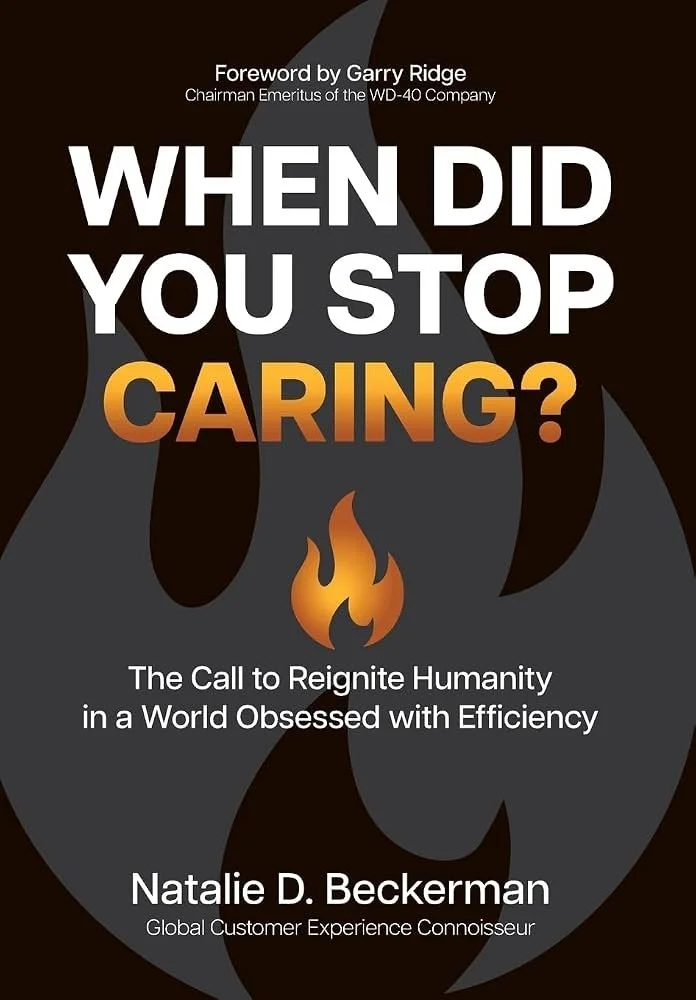
Natalie Beckerman opens When Did You Stop Caring with a childhood memory. At a grocery store, a cashier made her mother feel small for using coupons. Young Natalie took her mother’s hand and wanted to shop somewhere that valued their business. The incident did more than reveal an unkind employee. It exposed how frontline employee behaviors either make or break a brand.
Beckerman has spent three decades designing and leading service operations, including overseeing business process outsourcing (BPO) partners and later joining iQor as an executive. She writes with the authority of someone who has been accountable for the policies, scripts, technology, and escalation paths that determine whether people feel respected. Her question is aimed less at a rude cashier than at the leaders who create the conditions that shape an organization’s culture.
The book’s central argument is that caring is a leadership discipline. Good intentions alone cannot overcome a policy that prevents an employee from resolving a problem, a handoff that loses the customer’s history, or a scorecard that rewards shorter calls over first-time quality. Moreover, the leadership lessons in the book apply across all frontline employee experiences, not just call centers. Leaders make quality possible in the design of the work and visible in their own behavior.
The Caring Recession Is Built Into the System
Beckerman calls the drift toward indifference a caring recession. It appears when a company optimizes its own convenience while transferring effort to customers and stress to employees. A customer repeats the same story through several channels. An agent knows the right answer but lacks authority to give it. A digital journey is full of friction without solving the customer’s need. Each choice may appear efficient but is ultimately expedient, eroding value.
She calls out the right three lenses for judging an experience: effort, emotion, and trust. Did the company make the task easier? How did the interaction make the person feel? Did the brand keep its promise, including when something went wrong? These questions cut through claims about being “customer centric.” A brand is ultimately judged by the experience people have, not by the language it uses to describe itself.
That is why her discussion of service recovery matters. Customers do not expect perfection. They look for someone who owns the mistake, explains what will happen next, and follows through. A rigid policy can protect a transaction while damaging the relationship that made the transaction valuable.
Culture Lives in the Middle
The book is strongest when it moves from values to leadership choices. Beckerman argues that culture takes shape in what leaders reward, tolerate, and repeat. Senior executives may describe a caring culture, but supervisors and team leads translate that aspiration into the daily decisions employees are permitted to make. If those managers are unsupported or measured only on speed and cost, the message weakens before it reaches the frontline. It also leaves the frozen middle stuck in lack of trust of the organization, failing to tap into their emotional energy, sapping their motivation and commitment to change.
Her account of the culture reset at iQor, the Business Process Outsourcing (BPO) company at which she is EVP and Chief Business Officer, shows a different approach. Leadership first aligned on the future it wanted to build, then invited employees across roles and geographies into listening sessions and working groups. The resulting values were co-created rather than simply announced. The lesson is less about the wording of a mission statement than about who has a voice, how decisions change, and whether the organization keeps listening after the launch.
This connects to a recurring theme in my work on Leadership Experience, or LX. Leaders are not just messengers of culture. Their own experience of shaping expectations, creating the right environment, providing support, taking ownership, and being accountable shapes how they lead others. Team leads and supervisors need room to exercise judgment, coaching that develops habits, and metrics that recognize both the employee and customer outcomes they create. That is one reason my colleagues Simon Robinson, James Killian, Ph.D. and I are teaming on the LX Accelerator, which focuses on building leadership alignment on behaviors that reinforce a customer-driven culture.
Value = LX x (CX + EX). Intentional activation of a prioritized set of cultural behaviors amplifies real business value. And as Natalie so eloquently reinforces throughout all the stories in her book, you can’t create sustainable value without focusing on customer and employee experience. Without that focus, you are making expedient decisions chasing efficiency and cost that create a vicious cycle that erodes rather than boosts enterprise value.
AI Can Amplify Care or Frustration
Beckerman is rightly skeptical of technology deployed mainly to remove people from a service journey. She describes a familiar trap: automation handles the simplest inquiries, while the cases left for human agents become more complex and emotionally demanding. A plan that forecasts fewer contacts can miss the greater intensity of the remaining work. Digital deflection may reduce a company’s apparent cost while increasing the customer’s effort and the employee’s burnout.
Her warning is timely, and she pushes the argument further on how to combine AI with human empathy, judgement, and collaboration. AI cannot take responsibility for a relationship in the way a person or organization can, yet it can help people care more effectively. It can carry context across channels, surface an emerging service failure, help an agent understand a customer’s history, simulate difficult conversations so employees can practice, and provide coaching. Whether AI improves care depends on the goals, guardrails, and human behaviors around it.
That is where I see a connection to my own body of work on Organizational Intelligence: the ability to sense what customers and employees are experiencing, connect insights across functions, and turn them into better workflows and learning. In my recent Substack on Organizational Intelligence, my partners Randall Rothenberg and I write about the need to reimagine three things to fuse AI with human judgement, creativity, and caring: reimagine workflows, reimagine insights, and reimagine learning and development. The point is to close the loop between what the organization learns and what people are empowered to do. If leaders use AI only to automate a broken process, they will scale the frustration embedded in it.
The Business Case Is Broader Than a Cost Line
Beckerman makes the case that caring creates value through retention, advocacy, recovery, employee commitment, and avoided service failures. Those effects rarely fit neatly into one department’s quarterly efficiency target. A faster interaction is not necessarily a better one if the customer calls back, leaves, or tells others about the experience.
This echoes the Return on Experience work I led at PwC and our more recent focus at JourneySpark on the relationship among customer experience, employee experience, and leadership experience. Businesses need a system of metrics that reveal how experiences and emotions create a linkage to value. Beckerman’s emphasis on the impact of decisions is a useful reminder to ask what an “efficient” choice does to trust, dignity, and the organization’s capacity to serve people over time.
I also appreciated that she does not treat outsourcing as inherently opposed to care and strengthening the organization’s culture. Having worked on both sides of those relationships, she sees the potential for a BPO partner to bring specialized talent, resilience, process redesign, analytics, and better learning. The test is whether the partner shares accountability for outcomes and helps the company improve the whole service system, rather than merely absorbing volume at a lower unit cost.
From Conviction to Practice
The book closes with the Beckerman Caring Challenge, a four-quarter path from leadership alignment and honest diagnosis to system repair, reinforcement of trust, and ongoing renewal. It gives readers a way to move from agreement with the book’s principles to action. I would bring the behavior work forward in that sequence: assess what leaders and teams actually do today, define the behaviors that make the greatest difference, and use them to guide changes in policies, workflows, coaching, and measures from the start.
That is the lasting contribution of When Did You Stop Caring. It asks leaders to look past the service interaction in front of them and examine the organization that produced it. If a person is afraid to use judgment, if a customer has to fight the system to be heard, or if a manager has no way to act on what the frontline learns, the answer is not another slogan about empathy. It is a redesign of leadership and work.
I look forward to exploring these questions with Natalie on my podcast, The CX & Culture Connection. Her book belongs in a larger conversation about how leaders build organizations that learn, earn trust, and make care repeatable—even as AI changes how work gets done.
To see recent podcasts with guests whose books I’ve reviewed that address similar themes, like Gerald Zaltman (Dare to Think Differently), Bernie Jaworski (The Soul of Strategy), Simon Robinson (Designing Customer Experiences with Soul), and Benjamin Granger (A Leader Worth Following), click here. I’ll add my episode with Natalie there once it airs later this month.
You can also find the full collection of my book reviews here.
I hope this sparks some great ideas for you and energy to act!